English AI-assisted draft translation · not a scholarly edition
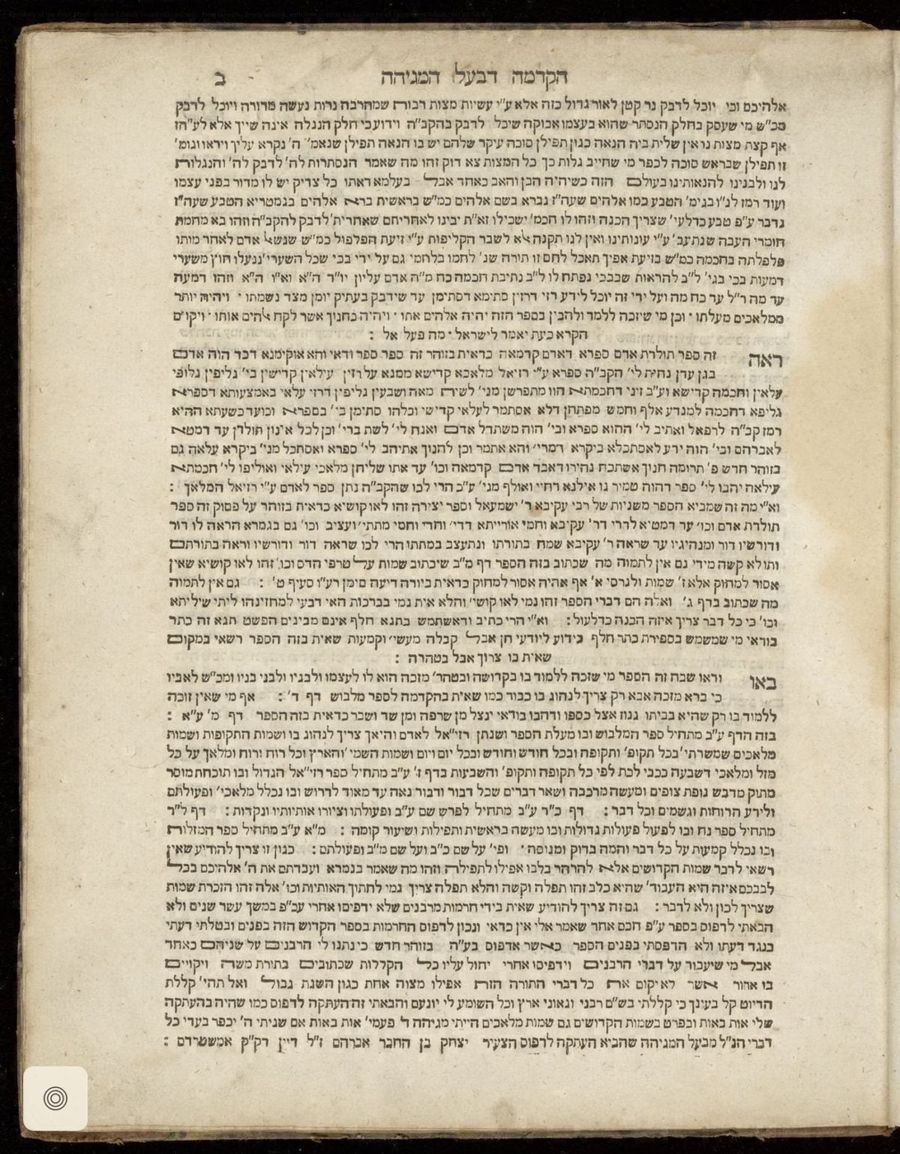
[Running head:] Preface of the proofreader (ba'al ha-magihah). [Folio] 2 (ב).
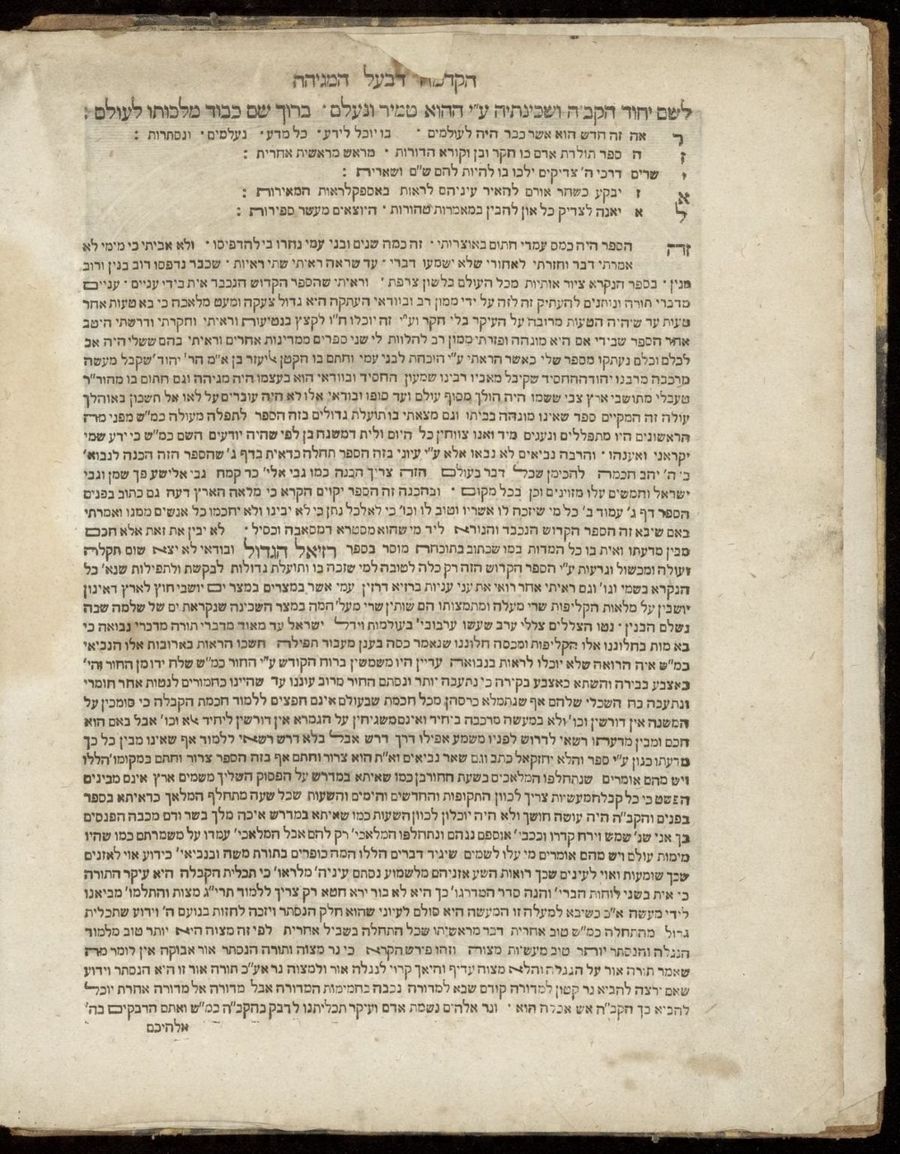
[…continuing from the previous folio:] "your God (אלהיכם, Eloheikhem)," etc. — Can a small candle cleave to so great a light? Only through the performance of many commandments, for from many candles a bonfire is made, and it can cleave.
All the more so one who occupies himself with the hidden part [of Torah], which is itself a torch that can cleave to the Holy One, blessed be He (הקב"ה). And it is known that the revealed part belongs only to this world (ע"הז).
Even some commandments that seem to have no benefit in them, such as tefillin [and] sukkah — their essence has benefit in it: tefillin, as it is said, "[the name of] the LORD (ה׳) is called upon you, and they shall fear [you]" etc. [Deut. 28:10] —
that is the tefillin of the head; sukkah — to atone for one who is liable to exile. So with all the commandments; go out and examine. This is what is said: "The hidden things belong to the LORD (ה׳)" [Deut. 29:28] — to cleave to the LORD; "and the revealed things
to us and to our children" — for our benefit in this world, when the son and the father will be as one. But [Aram.] in the world to come, every righteous man has a dwelling of his own.
And a further hint for us: in gematria "ha-teva" (nature) is like "Elohim" (אלהים), for this world was created with the name Elohim, as it is written "In the beginning Elohim created" [Gen. 1:1]; in gematria [it equals] ha-teva, for this world
[unclear: was created / is conducted] according to nature, as above, that it needs preparation. And this is: "O that they were wise, that they understood this, that they would consider their latter end" [Deut. 32:29] — for the latter end is to cleave to the Holy One, blessed be He. And this comes because of
the thick materiality that was thickened by our sins, and we have no remedy except to break the shells (kelippot) through the sweat of pilpul [dialectic], as it is said that Adam bore after his death
"…its pilpul in wisdom" [sic — citation as printed], as it is said "In the sweat of your face you shall eat bread" [Gen. 3:19] — this is Torah, as it is said "Come, eat of my bread" [Prov. 9:5]. Also through weeping, for all the gates were locked except the gates of
tears. "Bekhi" (weeping) in gematria is 32, to show that through weeping the 32 paths of wisdom are opened to him. "Mah" (what) — the power of "mah" [= 45], the supernal Adam: Yod He Vav He (יו"ד ה"א וא"ו ה"א) [spelled out = 45]. And this is "dim'ah" (tear) —
"ad mah" (until what), that is to say, until the power of mah. And by this he can know [Aram.] the secrets of secrets, the hidden of hidden things, until he cleaves to the Ancient of Days (עתיק יומין, Attiq Yomin) from the side of his soul • and his rank will be greater
than angels • And so whoever merits to learn and understand in this book, God (אלהים, Elohim) will be with him • and he will be like Enoch, whom God (אלהים) took • and the verse will be fulfilled:
"Now it shall be said to Israel • What has God (אל, El) wrought" [Num. 23:23].
[Margin: "See"] "This is the book of the generations of Adam" [Gen. 5:1] — [Aram.] the Book of Adam the First, as it is in the Zohar: "This is the book" — a book indeed. And we have established that when Adam was
in the Garden of Eden, the Holy One, blessed be He, sent down to him a book by means of Raziel (רזיאל), the holy angel appointed over the supernal holy secrets; in it were engraved supernal engravings
and holy wisdom, and seventy-two kinds of wisdom were expounded from it into six hundred and seventy engravings of supernal secrets. In the middle of the book
was an engraving of wisdom, to know one thousand five hundred keys that were not entrusted [even] to the holy supernal ones, and all of them were hidden in that book. [unclear] at that hour
the Holy One, blessed be He, hinted to Raphael (רפאל), and he returned that book to him, and Adam occupied himself with it, and [unclear: left/gave] it to Seth his son, and so to all those generations until it reached
Abraham, and by it he knew how to gaze into the glory of his Master; and it has been said. And so to Enoch a book was given, and he gazed from it into the supernal glory. [End Aram. quotation.] Also
in the Zohar Hadash, portion Terumah: [Aram.] "Enoch — there was found [in him] the radiance that Adam the First lost," etc., until: "supernal angelic messengers came and taught him supernal wisdom;
they gave him a book that had been hidden within the Tree of Life, and he learned from it." Until here. — Behold, [this shows] you that the Holy One, blessed be He, gave a book to Adam by means of Raziel the angel (רזיאל המלאך).
And if you say: what is this, that the book brings mishnayot of Rabbi Akiva, Rabbi Ishmael, and the Sefer Yetzirah? This is no difficulty, as it is in the Zohar on the verse "This is the book
of the generations of Adam," etc., until: [Aram.] "it reached the generation of Rabbi Akiva, and he saw his Torah and rejoiced, and saw his death and was grieved," etc. Also in the Gemara: He showed him [each] generation
and its expounders, generation and its leaders, until he saw Rabbi Akiva — he rejoiced in his Torah and was grieved at his death. Behold, [this shows] you that he saw [each] generation and its expounders and saw their Torah,
and [Aram.] there is no further difficulty at all. Also one should not wonder at what is written in this book, folio 42, that one should write names on myrtle leaves, etc. This is no difficulty, for it is not
forbidden to erase except the seven names, and according to one reading even Ehyeh (אהיה) is forbidden to erase, as it is in Yoreh De'ah, siman 276, se'if 9. Also one should not wonder at
what is written on folio 3, "And these are the words of the book." This too is no difficulty; for is there not also in [tractate] Berakhot: [Aram.] "whoever wishes to see them, let him bring the afterbirth"
etc. — for every thing needs some preparation, as above. And if you say: but it is written [Aram.] "and whoever makes use of the crown (taga) passes away" [Avot 1:13] — they do not understand the plain sense: taga, this is Keter (crown);
certainly whoever makes use of the sefirah of Keter passes away, as is known to the knowers of grace (ח"ן, hidden wisdom). But practical Kabbalah and amulets that are in this book are permitted, in a place
where there is need, but in purity.
[Margin: "Come"] and see the praise of this book: whoever merits to learn in it in holiness and purity brings merit to himself and to his sons and his sons' sons, and all the more so to his father,
for [Aram.] "a son brings merit to the father"; only one must treat it with honour, as is [written] in the introduction to the Book of the Vestment (ספר מלבוש), folio 4. Even one who does not merit
to learn in it, but only that it be in his house, hidden beside his silver and gold — certainly he will be saved from burning and from a demon and from breakage, as it is in this book, folio 40a.
On this folio, side b, begins the Book of the Vestment, and in it the virtue of the book, and that Razi'el (רזי"אל) gave it to Adam, and how one must conduct oneself with it, and the names of the seasons (tequfot), and the names of
the angels who serve in each and every season, and in each and every month, and in each and every day, and the names of the heavens and the earth, and each and every wind, and the angel over each
constellation, and the angels of the seven planets according to each season; and the adjurations. On folio 7b begins the Great Book of Razi'el, and in it moral rebuke
sweeter than honey and the honeycomb, and the Work of the Chariot (ma'aseh merkavah), and other matters, every single word of which is exceedingly fine to expound; and in it are included angels and their workings,
and to know the winds and rains and every thing. Folio [unclear: 24/2?]b begins to explain the Name of 72 (שם ע"ב) and its working, and its form, its letters and vowel-points. Folio [unclear: 34/3?]
begins the Book of Noah, and in it to work great workings, and in it the Work of Creation (ma'aseh bereshit), and prayers, and Shi'ur Qomah. [Folio] 41b begins the Book of the Constellations (mazalot),
and in it are included amulets for every thing, and they are tested and tried • and an explanation of the Name of 22 and the Name of 42 and their workings. Such as this, it must be made known that one is not
permitted to speak the holy names, but only to meditate in his heart, even for prayer. And this is what is said in the Gemara: "and you shall serve the LORD (ה׳) your God (אלהיכם) with all
your heart" [cf. Deut. 11:13] — which is the service that is in the heart? This is prayer. And it is difficult: but prayer also needs the letters to be articulated, etc.? Rather, this is the mention of names,
which one must intend and not speak. This too must be made known: that I hold bans (ḥaramot) from rabbis that none shall reprint [it] after me, against their will (עב"פ), for a period of ten years. And I did not
bring them to print in the book, according to another sage who said to me that it is not fitting and proper to print the bans inside this holy book; and I set aside my opinion
before his opinion, and did not print them inside the book, as I shall print, with God's help (בע"ה), in the Zohar Hadash, for the rabbis gave them to me for both together.
But whoever transgresses the words of the rabbis and reprints after me, all the curses written in the Torah of Moses shall fall upon him, and there shall be fulfilled
in him: "Cursed be he who does not uphold the words of this Torah" [Deut. 27:26] — even one commandment, such as encroaching on a boundary. And let not the curse of
a common man be light in your eyes, for my curse is [by] the Talmud (ש"ס), the rabbis and the Geonim of the land. And whoever listens to me shall be made pleasant. And I brought this copy to print just as it was in the copy
of mine, letter by letter, and especially in the holy names; also the names of angels I proofread four (ד׳) times, letter by letter. If I have erred, may the LORD (ה׳) atone for me. All
the aforesaid words are from the proofreader, who brought the copy to print, the young Isaac son of the ḥaver Abraham, of blessed memory, judge (dayyan) of the holy community of Amsterdam.