Hall of Raziel™ , found with , and of the Ages Raziel's Mercy™ Found a phone? Raziel's Mercy™ shows a calm blessing screen with a simple invitation: call the owner. A masked Call button reaches them without showing their number. No pressure. No threats. For finders → Raziel's Library™ The complete 1701 Amsterdam printing of the Book of the Angel Raziel, read page by page from the scans: Hebrew and English side by side, in six parts, with notes on missing and duplicated pages. AI-assisted draft. Enter the Library → Hall of Raziel™ chat room Coming Soon. In the meantime, join us on RUEZALS.chat. Enter RUEZALS.chat Raziel's Mercy™ A lost Android recovery system. When your phone is lost, Mercy turns its screen into a calm, clear, kind blessing so whoever finds it knows how to help. If the phone can't come home, remote erase is there as the last safeguard. How Mercy works → Raziel speaks (paraphrased)
Raziel’s Library™ › The Book of the Angel Raziel › Pages 45–54

Hall of Raziel™ · Sefer Raziel ha-Malakh, Amsterdam 1701

The Book of the Angel Raziel · Pages 45–54

The zodiac spheres, the Teli, weather signs, the River of Fire, the princes of the months

AI-assisted draft. The Hebrew was re-read from the 1701 scans and the English is an AI-assisted draft translation, not a scholarly edition. Check the scan before you rely on any reading.

PDF: 04-Book-of-the-Angel-Raziel-part04-pp045-054 (2,660 KB)

Jump to: 46 45 48 47 50 49 52 51 54 53

1 comparison note on this part (gold boxes).

Hebrew as printed, read from the scan
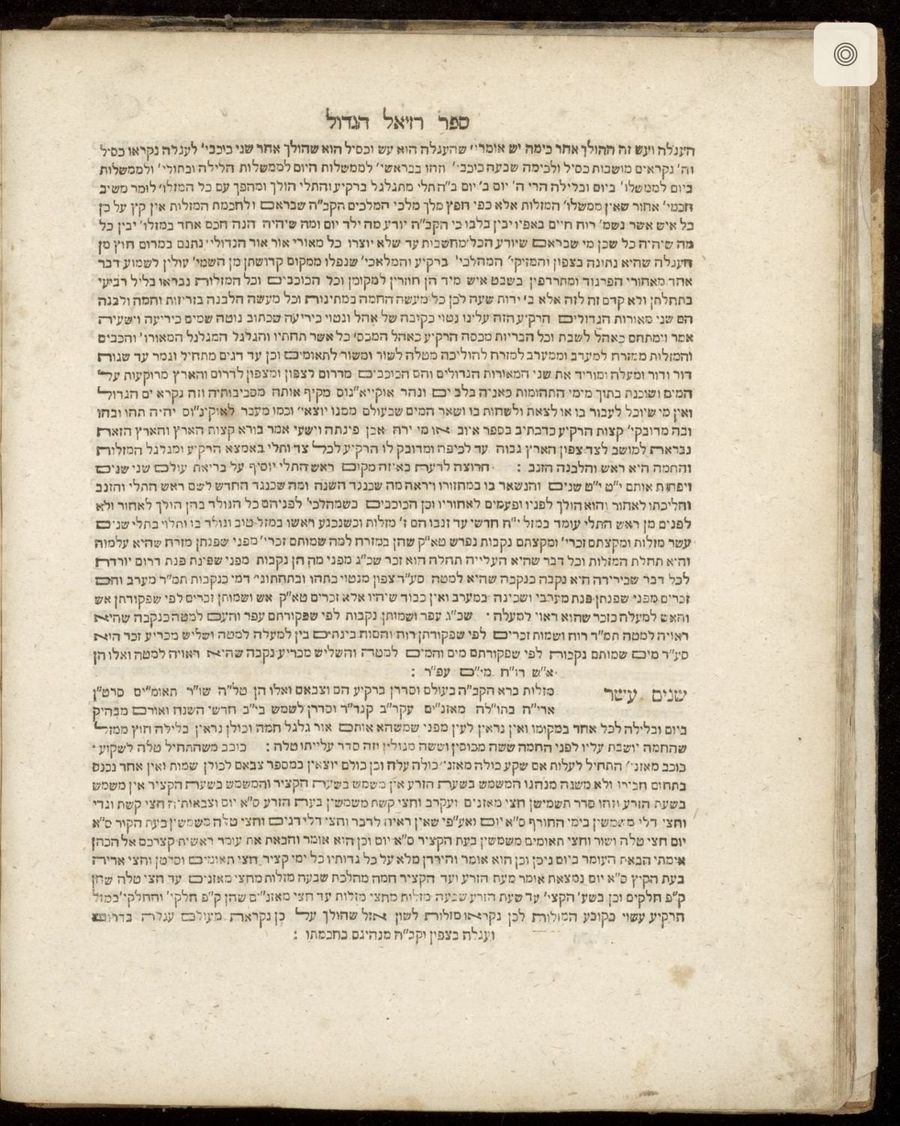
1701 printed page, scan page 46. Page image: Embassy of the Free Mind (Bibliotheca Philosophica Hermetica), Amsterdam, shelfmark Q, via Source Library. Public domain
Tap to open the scanPage image: Embassy of the Free Mind (Bibliotheca Philosophica Hermetica), Amsterdam, shelfmark Q, via Source Library. Public domain (CC PDM 1.0).
[p46 — folio יח verso] העגלה ועש זה ההולך אחר כימה יש אומרים שהעגלה הוא עש וכסיל הוא שהולך אחר שני כוכבי' לעגלה נקראו כסיל וה' נקראים מושבות כסיל ולכימה שבעה כוכבי' וזהו בבראשי' לממשלות היום לממשלות הלילה ובחולי' ולממשלות ביום לממשלו' ביום ובלילה הרי ה' יום ב' יום ב"ה התלי מתגלגל ברקיע והתלי הולך ומהפך עם כל המזלו' לומר משיב חכמי' אחור שאין ממשלו' המזלות אלא כפי חפץ מלך מלכי המלכים הקב"ה שבראם ולחכמת המזלות אין קץ על כן כל איש אשר נשמ' רוח חיים באפיו יבין בלבו כי הקב"ה יודע מה ילד יום ומה שיהיה הנה חכם אחד במזלו' יבין כל מה שיהיה כל שכן מי שבראם שיודע הכל מחשבות עד שלא יוצרו כל מאורי אור הגדולי' נתנם במרום חוץ מן העגלה שהיא נתונה בצפון והמזיקי' המהלכי' ברקיע והמלאכי' שנפלו ממקום קדושתן מן השמי' עולין לשמוע דבר אחר מאחורי הפרגוד ומתרפין בשבט איש מיד הן חוזרין למקומן וכל הכוכבים וכל המזלות נבראו בליל רביעי בתחלתן ולא קדם זה לזה אלא ב' ירות שעה לכן כל מעשה החמה במתינות וכל מעשה הלבנה בזריזות וחמה ולבנה הם שני מאורות הגדולים הרקיע הזה עלינו נטוי כקובה של אהל ונטוי כיריעה שכתוב נוטה שמים כיריעה וישעיה אמר וימתחם כאהל לשבת וכל הבריות מכסה הרקיע כאהל המכסה כל אשר תחתיו והגלגל המגלגל המאורו' והככבים והמזלות ממזרח למערב וממערב למזרח להוליכה מטלה לשור ומשור לתאומים וכן עד דגים מתחיל וגומר עד שגורת דור ודור ומעלה ומוריד את שני המאורות הגדולים והם הכוכבים מדרום לצפון ומצפון לדרום והארץ מרוקעות על המים ושוכנת בתוך מימי התהומות כאניה בלב ים ונהר אוקיא"נוס מקיף אותה מסביבותיה וזה נקרא ים הגדול ואין מי שיוכל לעבור בו או לצאת ולשחות בו ושאר המים שבעולם ממנו יוצאי' וכמו מעבר לאוקינ"וס יהיה תהו ובהו ובה מרובקי' קצות הרקיע כדכתיב בספר איוב או מי ירה אבן פינתה וישעי' אמר בורא קצות הארץ והארץ הזאת נבראת למושב לצד צפון הארץ גבוה עד לכיפה ומדובק לו הרקיע לכל צד ותלי באמצע הרקיע ומגלגל המזלות והחמה היא ראש והלבנה הזנב : הרוצה לדעת באיזה מקום ראש התלי יוסיף על בריאת עולם שני שנים ויפחות אותם י"ט י"ט שנים והנשאר בו במחזורו ויראה מה שכנגד השנה ומה שכנגד החדש לשם ראש התלי והזנב והליכתו לאחור והוא ההולך לפניו ופעמים לאחוריו וכן הכוכבים כשמהלכי' לפניהם כל הנולד בהן הולך לאחור ולא לפנים מן ראש התלי עומד במזל י"ח חדשי' עד זנבו הם ז' מזלות וכשנכנע ראשו במזל טוב ונולד בו ותלוי בתלי שנים עשר מזלות ומקצתם זכרי' ומקצתם נקבות נפרש טא"ק שהן במזרח למה שמותם זכרי' מפני שפנתן מזרח שהיא עלמוה והיא תחלת המזלות וכל דבר שהיא העלייה תחלה הוא זכר שב"ג מפני מה הן נקבות מפני שפנת פנת דרום יורדת לכל דבר שבירידה היא נקבה כנקבה שהיא למטה סע"ר צפון מנטוי בתהו ובתחתונו' דמי כנקבות תמ"ד מערב והם זכרים מפני שפנתן פנת מערבי ושכינה במערב ואין כבוד שיהיו אלא זכרים טא"ק אש ושמותן זכרים לפי שפקורתן אש והאש למעלה כזכר שהוא ראוי למעלה · שב"ג עפר ושמותן נקבות לפי שפקורתם עפר והעם למטה כנקבה שהיא ראויה למטה תמ"ד רוח ושמות זכרים לפי שפקורתן רוח והסות בינתים בין למעלה למטה ושליש מכריע זכר הוא סע"ר מים שמותם נקבות לפי שפקורתם מים והמים למטה והשליש מכריע נקבה שהיא ראויה למטה ואלו הן א"ש רו"ח מי"ם עפ"ר : שנים עשר מזלות ברא הקב"ה בעולם וסדרן ברקיע הם וצבאם ואלו הן טל"ה שו"ר תאומ"ים סרט"ן ארי"ה בתול"ה מאזנ"ים עקר"ב קשת גדי דלי דגים [as printed: קנר"ד] וסדרן לשמש בי"ב חדשי השנה ואורם מבהיק ביום ובלילה לכל אחד במקומו ואין נראין לעין מפני שמשהא אותם אור גלגל חמה וכולן נראין בלילה חוץ ממזל שהחמה יושבת עליו לפני החמה ששה מכוסין וששה מגולין וזה סדר עלייתו טלה : כוכב משהתחיל טלה לשקוע כוכב מאזנ"' התחיל לעלות אם שקע כולה מאזני' כולה עלה וכן כולם יוצאין במספר צבאם לכולן שמות ואין אחד נכנס בתחום חבירו ולא משנה מנהגו המשמש בשעת הזרע אין משמש בשעת הקציר והמשמש בשעת הקציר אין משמש בשעת הזרע וזהו סדר תשמישן חצי מאזנים ועקרב ועקרב וחצי קשת משמשין בעת הזרע ס"א יום וצבאות זה חצי קשת וגדי וחצי דלי משמשין בימי החורף ס"א יום ואע"פ שאין ראיה לדבר וחצי דלי דגים וחצי טלה משמשין בעת הקור ס"א יום חצי טלה ושור וחצי תאומים משמשין בעת הקציר ס"א יום וכן הוא אומר והבאת את עומר ראשית קצירכם אל הכהן אימתי הבאת העומר ביום ניסן וכן הוא אומר והירדן מלא על כל גדותיו כל ימי קציר חצי תאומים וסרטן וחצי אריה בעת הקיץ ס"א יום נמצאת אומר מעת הזרע ועד הקציר חמה מהלכת שבעה מזלות מחצי מאזנים עד חצי טלה שהן ק"פ חלקים וכן בשע' הקצי' עד שעת הזרע שבעה מזלות מחצי עד חצי מאזנ"ים שהן ק"פ חלקי' והחלקי' במזל הרקיע עשוי כקובע המזלות לכן נקראו מזלות לשון אזל שהולך על כן נקראת מעולם עגלה בדרום ועגלה בצפון וקב"ה מנהיגם בחכמתו :

English AI-assisted draft translation · not a scholarly edition

p46 (folio יח verso). AI-assisted draft translation, not a scholarly edition. Literal; uncertain readings [unclear], misprints [sic]. This page follows HebrewBooks folio יח recto, which ends "Kesil is the Calf". …the Wagon (העגלה); and ʿAsh (עש) is the one that goes after Kimah (the Pleiades). Some say the Wagon is ʿAsh, and Kesil (Orion) is the one that goes after two stars; for the Wagon they are called Kesil, and five are called "the bands of Kesil" (Job 38:31), and Kimah has seven stars. This is [what is] in Bereshit: "to rule the day and to rule the night" (Gen. 1:16) [the rest of the clause is confused; unclear]. The Teli (התלי, the Dragon) revolves in the firmament; the Teli goes and turns with all the signs, to say "who turns the wise backward" (Isa. 44:25): the dominion of the signs is only according to the will of the King of the kings of kings, the Holy One, blessed be He, who created them; and to the wisdom of the signs there is no end. Therefore let every man "in whose nostrils is the breath of the spirit of life" (Gen. 7:22) understand in his heart that the Holy One, blessed be He, knows "what a day may bring forth" (Prov. 27:1) and what will be. If one sage, by the signs, understands all that will be, all the more He who created them, who knows all thoughts before they are formed. All the great lights He set on high, except the Wagon, which is set in the north; and the harmful spirits that walk in the firmament, and the angels that fell from their place of holiness in heaven, go up to hear a word from behind the curtain (pargod), and are driven back [unclear: ומתרפין] with a rod; at once they return to their place. All the stars and all the signs were created on the night of the fourth [day] at their beginning, and none preceded the other except by two parts [unclear: ירות] of an hour. Therefore every work of the sun is with slowness and every work of the moon with quickness; and sun and moon are the two great lights. This firmament above us is stretched like the dome of a tent and spread like a curtain, as it is written "who stretches out the heavens like a curtain" (Ps. 104:2), and Isaiah said "and spreads them out as a tent to dwell in" (Isa. 40:22). And the firmament covers all creatures like a tent that covers all that is beneath it. And the sphere (galgal) rolls the lights, the stars and the signs from east to west and from west to east, to lead [them] from Aries to Taurus and from Taurus to Gemini, and so to Pisces; it begins and finishes [unclear: עד שגורת] generation after generation, and raises and lowers the two great lights and the stars from south to north and from north to south. And the earth is spread out upon the waters and dwells within the waters of the deeps like a ship in the heart of the sea, and the river Oceanus (אוקיאנוס) surrounds it on every side; this is called the Great Sea, and there is none who can cross it or go out or swim in it; and all the other waters of the world issue from it; and beyond Oceanus it is as tohu and bohu (void). And in it are fastened the ends of the firmament, as it is written in the book of Job "or who laid its corner-stone?" (Job 38:6), and Isaiah said "Creator of the ends of the earth" (Isa. 40:28). And this earth was created as a dwelling toward the north side; the earth is high up to the vault, and the firmament is joined to it on every side. And the Teli is in the middle of the firmament and turns the signs; the sun [sic, read "the Teli"?] is the head and the moon the tail. Whoever wishes to know in what place the head of the Teli is: let him add two years to [the years since] the creation of the world, and subtract from them [cycles of] 19 years, 19 years, and [take] what remains in its cycle, and see what corresponds to the year and what corresponds to the month — there is the head of the Teli and the tail. Its going is backward: it is what goes before him [unclear] and sometimes behind him; and likewise the stars when they go before them — everyone born in them goes backward and not forward. From the head of the Teli [it] stands in a sign 18 months; to its tail are seven signs. And when its head is subdued [unclear: נכנע] in a good sign and one is born in it, and hangs on the Teli… Twelve signs — some of them male and some female. We will explain: Ṭ-A-Q [Ṭaleh (Aries), Aryeh (Leo), Qeshet (Sagittarius)] are in the east. Why are their names male? Because their corner is the east, which is ascent [unclear: עלמוה], and it is the beginning of the signs, and everything that is ascent first is male. Sh-B-G [Shor (Taurus), Betulah (Virgo), Gedi (Capricorn)] — why are they female? Because their corner is the south corner, descending; everything in descent is female, like the female who is below. S-ʿ-R [Sarṭan (Cancer), ʿAqrav (Scorpio), Dagim (Pisces) — sic, "ר"]: north, stretched over tohu and the lower [regions], like females. T-M-D [Teʾomim (Gemini), Moznayim (Libra), Deli (Aquarius)]: west, and they are male, because their corner is the western corner and the Shekhinah is in the west, and it is not fitting that they be other than male. Ṭ-A-Q: fire, and their names male, because their element (פקורתן, sic) is fire, and fire is above, like the male who is fit to be above. Sh-B-G: earth, and their names female, because their element is earth and the people [sic, for "earth"] are below, like the female who is fit to be below. T-M-D: wind (air), and male names, because their element is wind, which is between, between above and below, and the third tips the balance: it is male. S-ʿ-R: water; their names female, because their element is water, and the waters are below, and the third tips toward the female, who is fit to be below. And these are: fire, wind, water, earth. [Display words] TWELVE signs the Holy One, blessed be He, created in the world and arranged them in the firmament, they and their host. These are: Ṭaleh (Aries), Shor (Taurus), Teʾomim (Gemini), Sarṭan (Cancer), Aryeh (Leo), Betulah (Virgo), Moznayim (Libra), ʿAqrav (Scorpio), [Qeshet (Sagittarius), Gedi (Capricorn), Deli (Aquarius), Dagim (Pisces) — abbreviated in print as קנר"ד, sic]. And He arranged them to serve the sun in the twelve months of the year. Their light shines by day and by night, each in its place, but they are not seen by the eye [by day] because the light of the sun's sphere delays them [unclear: שמשהא]; and all of them are seen at night except the sign on which the sun sits. Before the sun six are covered and six uncovered. And this is the order of its rising: Aries. When the star [sign] of Aries begins to set, the star of Libra begins to rise; when Aries has wholly set, Libra has wholly risen; and so all of them go out by the number of their host; all of them have names (cf. Isa. 40:26), and none enters the boundary of its fellow nor changes its custom. The one that serves in the time of sowing does not serve in the time of harvest, and the one that serves at harvest does not serve at sowing. This is the order of their service: half of Libra, Scorpio, and half of Sagittarius serve at the time of sowing, 61 days; and these are hosts [unclear]. Half of Sagittarius, Capricorn and half of Aquarius serve in the days of winter, 61 days, although there is no proof of the matter. Half of Aquarius, Pisces and half of Aries serve in the time of cold, 61 days. Half of Aries, Taurus and half of Gemini serve in the time of harvest, 61 days; and so it says "and you shall bring the sheaf of the first of your harvest to the priest" (Lev. 23:10) — when is the bringing of the sheaf? In the days of Nisan; and so it says "and the Jordan overflows all its banks all the days of harvest" (Josh. 3:15). Half of Gemini, Cancer and half of Leo in the time of summer, 61 days. So you find it said: from the time of sowing to the harvest the sun travels seven signs, from half of Libra to half of Aries, which are 180 parts; and likewise from the time of harvest to the time of sowing, seven signs, from half [of Aries] to half of Libra [sic], which are 180 parts; and the parts are in the sign [unclear]. The firmament is made like the fixed setting [unclear: כקובע] of the signs; therefore they are called mazzalot (signs), from the word azal, "that goes". Therefore it is called from of old "a Wagon in the south and a Wagon in the north", and the Holy One, blessed be He, guides them in His wisdom. [No catchword visible.]
Scripture on this page · 12 references with the KJV text

References are given as printed, in Hebrew chapter and verse numbering. Where the KJV numbers the verse differently (mostly Psalms, which count the title as verse 1 in Hebrew), the KJV reference is shown. KJV text: King James Version (1769 text), public domain; text from github.com/thiagobodruk/bible (en_kjv.json), fetched 28 Oct 2026. Genesis, Exodus and Leviticus also show the Gutenberg Bible on this site (/gb/): Latin Vulgate in Gutenberg spelling with the Douay-Rheims English.

  • Job 38:31
    KJV: Canst thou bind the sweet influences of Pleiades, or loose the bands of Orion?
  • Genesis 1:16
    KJV: And God made two great lights; the greater light to rule the day, and the lesser light to rule the night: he made the stars also.
    Gutenberg Bible, leaf 005r: Fecitque Deus duo luminaria magna: luminare maius, ut preesset diei: et luminare minus, ut preesset nocti: et stellas. — And God made two great lights: a greater light to rule the day; and a lesser light to rule the night: and the stars.
  • Isaiah 44:25
    KJV: That frustrateth the tokens of the liars, and maketh diviners mad; that turneth wise men backward, and maketh their knowledge foolish;
  • Genesis 7:22
    KJV: All in whose nostrils was the breath of life, of all that was in the dry land , died.
    Gutenberg Bible, leaf 007v: et cuncta, in quibus spiraculum vite est in terra, mortua sunt. — And all things wherein there is the breath of life on the earth, died.
  • Proverbs 27:1
    KJV: Boast not thyself of to morrow; for thou knowest not what a day may bring forth.
  • Psalms 104:2
    KJV: Who coverest thyself with light as with a garment: who stretchest out the heavens like a curtain:
  • Isaiah 40:22
    KJV: It is he that sitteth upon the circle of the earth, and the inhabitants thereof are as grasshoppers; that stretcheth out the heavens as a curtain, and spreadeth them out as a tent to dwell in:
  • Job 38:6
    KJV: Whereupon are the foundations thereof fastened? or who laid the corner stone thereof;
  • Isaiah 40:28
    KJV: Hast thou not known? hast thou not heard, that the everlasting God, the LORD , the Creator of the ends of the earth, fainteth not, neither is weary? there is no searching of his understanding.
  • Isaiah 40:26
    KJV: Lift up your eyes on high, and behold who hath created these things , that bringeth out their host by number: he calleth them all by names by the greatness of his might, for that he is strong in power; not one faileth.
  • Leviticus 23:10
    KJV: Speak unto the children of Israel, and say unto them, When ye be come into the land which I give unto you, and shall reap the harvest thereof, then ye shall bring a sheaf of the firstfruits of your harvest unto the priest:
    Gutenberg Bible, leaf 060r: Loquere filiis Israel, et dices ad eos: Cum ingressi fueritis terram, quam ego dabo vobis, et messueritis segetem, feretis manipulos spicarum, primitias messis vestre, ad sacerdotem: — Speak to the children of Israel, and thou shalt say to them: When you shall have entered into the land which I will give you, and shall reap your corn, you shall bring sheaves of ears, the firstfruits of your harvest to the priest.
  • Joshua 3:15
    KJV: And as they that bare the ark were come unto Jordan, and the feet of the priests that bare the ark were dipped in the brim of the water, (for Jordan overfloweth all his banks all the time of harvest,)

Hebrew as printed, read from the scan
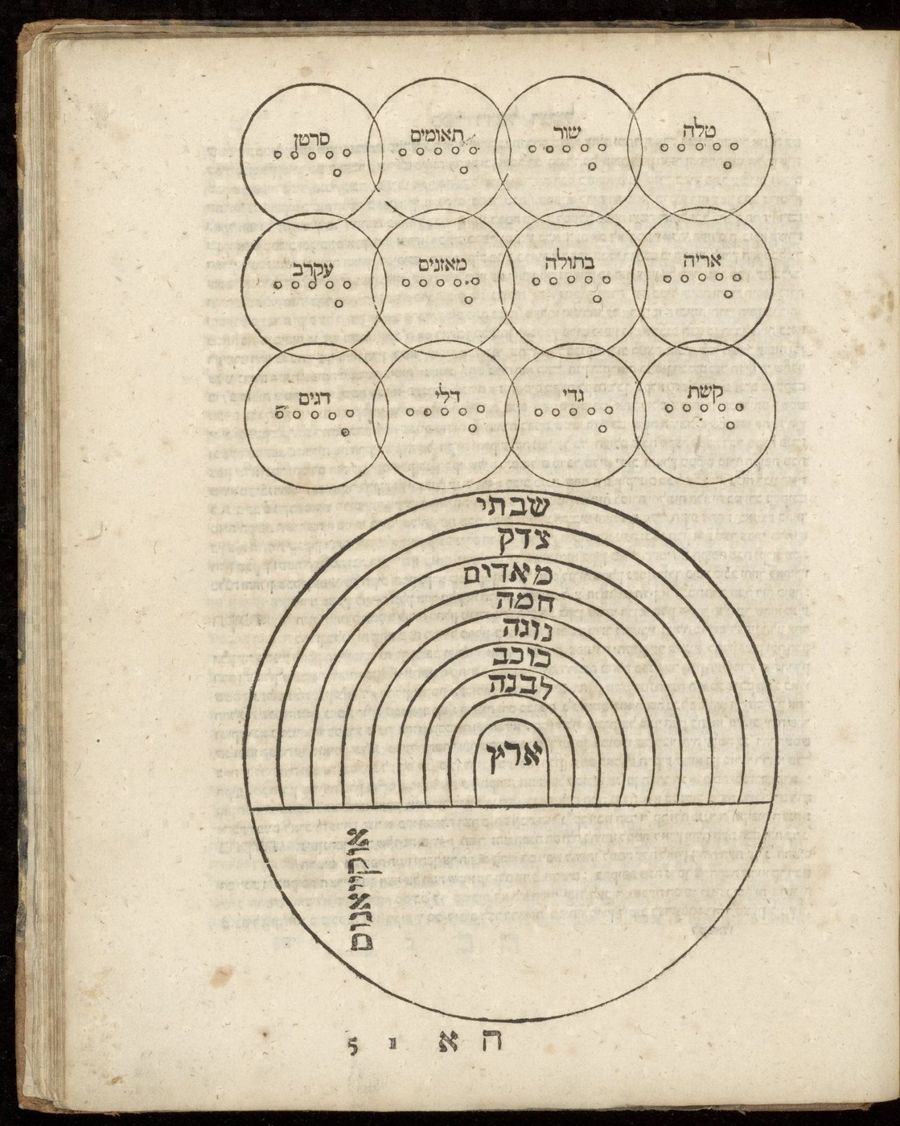
1701 printed page, scan page 45. Page image: Embassy of the Free Mind (Bibliotheca Philosophica Hermetica), Amsterdam, shelfmark Q, via Source Library. Public domain
Tap to open the scanPage image: Embassy of the Free Mind (Bibliotheca Philosophica Hermetica), Amsterdam, shelfmark Q, via Source Library. Public domain (CC PDM 1.0).
[p45 — diagram page (art); labels only] [upper: twelve intersecting circles, each with six small rings (5 in a row + 1 below)] טלה · שור · תאומים · סרטן · אריה · בתולה · מאזנים · עקרב · קשת · גדי · דלי · דגים [lower: concentric arcs, outermost to innermost] שבתי · צדק · מאדים · חמה · נוגה · כוכב · לבנה · ארץ

English AI-assisted draft translation · not a scholarly edition

p45 — DIAGRAM (treated as art; see scan). AI-assisted draft translation, not a scholarly edition. The page has no running text; only the printed labels are given here. Faint show-through of text from the other side of the leaf is not translated. Upper part: twelve intersecting circles, one for each sign of the zodiac. Each circle has a row of five small rings with a sixth below them, probably stars or the sign's host [unclear]. Labels: Ṭaleh (טלה) Aries · Shor (שור) Taurus · Te'omim (תאומים) Gemini · Sarṭan (סרטן) Cancer · Aryeh (אריה) Leo · Betulah (בתולה) Virgo · Moznayim (מאזנים) Libra · 'Aqrav (עקרב) Scorpio · Qeshet (קשת) Sagittarius · Gedi (גדי) Capricorn · Deli (דלי) Aquarius · Dagim (דגים) Pisces. Lower part: concentric arcs around the earth showing the seven planetary spheres. They are labelled from outermost to innermost: Shabbetai (שבתי) Saturn · Tsedeq (צדק) Jupiter · Ma'adim (מאדים) Mars · Ḥammah (חמה) Sun · Nogah (נוגה) Venus · Kokhav (כוכב) Mercury · Levanah (לבנה) Moon · Erets (ארץ) Earth, at the centre. The order matches the planetary heights on HB folio יח recto, which places Saturn uppermost and the Moon lowest.

Hebrew as printed, read from the scan

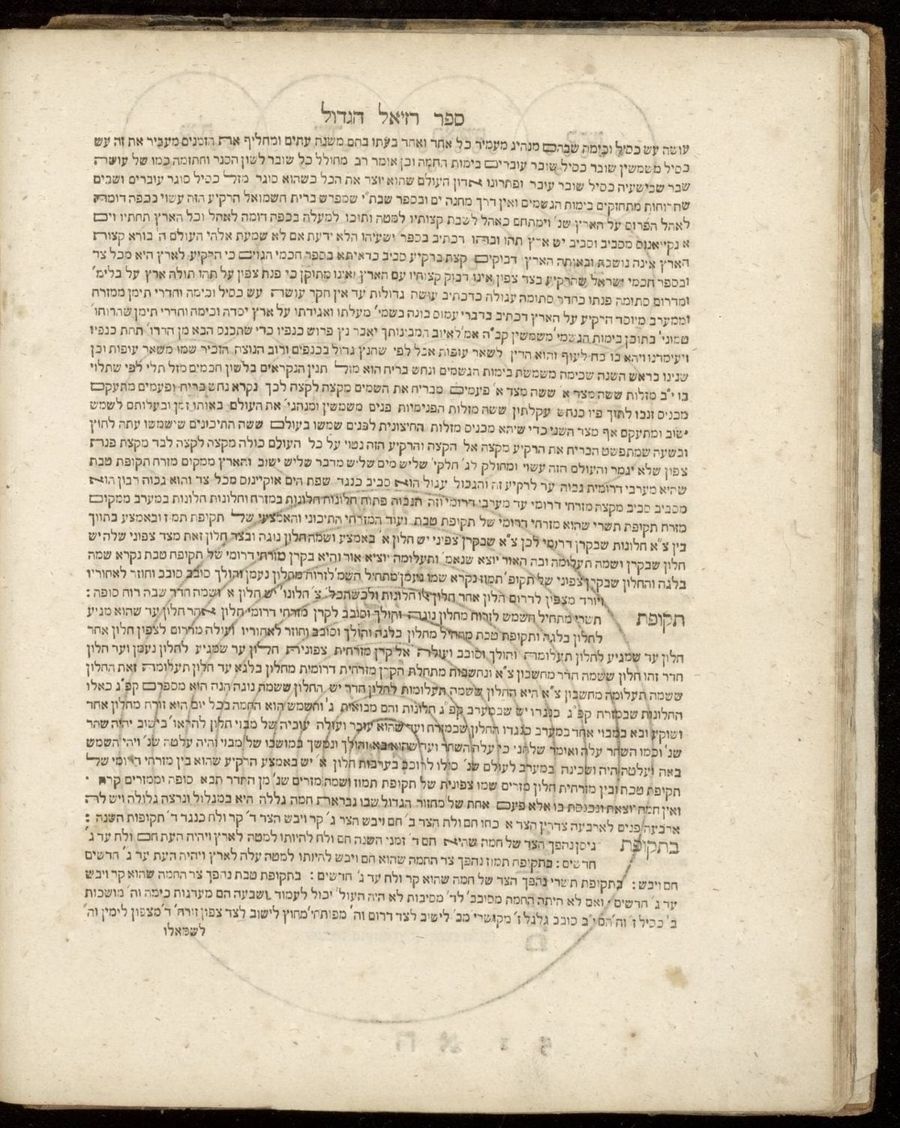
1701 printed page, scan page 48. Page image: Embassy of the Free Mind (Bibliotheca Philosophica Hermetica), Amsterdam, shelfmark Q, via Source Library. Public domain
Tap to open the scanPage image: Embassy of the Free Mind (Bibliotheca Philosophica Hermetica), Amsterdam, shelfmark Q, via Source Library. Public domain (CC PDM 1.0).
[p48] עושה עש כסיל וכימה שבהם מנהיג מעמיד כל אחד ואחד בעתו בהם משנה עתים ומחליף את הזמנים מעביר את זה עש כסיל משמשין שובר כסיל שובר עוברים בימות החמה וכן אומר רב מחולל כל שובר לשון הכנר וחתומה כמו של עושה שבר שבישעיה כסיל שובר עובר ופתרונו אדון העולם שהוא יוצר את הכל כשהוא סוגר מזל כסיל סוגר עוברים ושגים שהרוחות מתחזקים בימות הגשמים ואין דרך מחנה ים ובספר שבת"י שמפרש ברית חשמואל הרקיע הזה עשוי בכפה דומה לאהל הפרוס על הארץ שנ' וימתחם כאהל לשבת קצותיו למטה ותוכו למעלה בכפה דומה לאהל וכל הארץ תחתיו וים אוקייאנוס מסביב וסביב יש ארץ תהו ובהו דכתיב בספר ישעיהו הלא ידעת אם לא שמעת אלהי העולם ה' בורא קצות הארץ אינה נושבת ובאותה הארץ דבוקים קצת ברקיע סביב כדאיתא בספר חכמי הגוים כי הרקיע לארץ היא מכל צד ובספר חכמי ישראל שהרקיע בצד צפון אינו דבוק קצותיו עם הארץ ואינו מתוקן כי פנת צפון על תהו תולה ארץ על בלימ' ומדרום סתומה פנתו כחדר סתומה עגולה כדכתיב עושה גדולות עד אין חקר עושה עש כסיל וכימה וחדרי תימן ממזרח וממערב מיוסד הרקיע על הארץ דכתיב בדברי עמוס בונה בשמי' מעלתו ואגודתו על ארץ יסדה וכימה וחדרי תימן שהרוחו' טמוני' בתוכן בימות הגשמי' משמשין קב"ה אמ' לאיוב המבינתך יאבר נץ פרוש כנפיו כדי שתכנס הבא מן הדרו' תחת כנפיו ויעמידנו והוא בו כח לעוף והוא הדין לשאר עופות אבל לפי שהנץ גדול בכנפים ורוב הנוצה הזכיר שמו משאר עופות וכן שנינו בראש השנה שכימה משמשת בימות הגשמים ונחש בריח הוא מזל תנין הנקראים בלשון חכמים מזל תלי לפי שתלוי בו י"ב מזלות ששה מצד א' ששה מצד א' פעמים מבריח את השמים מקצה לקצה לכך נקרא נחש בריח ופעמים מתעקם מכנים זנבו לתוך פיו כנחש עקלתון ששה מזלות הפנימיות פנים משמשין ומנהגי' את העולם באותו זמן ובעלותם לשמש ישוב ומתעקם אף מצד השני כדי שיהא מכנים מזלות החיצונית לפנים שמשו בעולם ששה התיכונים שישמשו עתה לחוץ ובשעה שמתפשט הבריח את הרקיע מקצה אל הקצה והרקיע הזה נטוי על כל העולם כולה מקצה לקצה לבד מקצת פנת צפון שלא יגמר והעולם הזה עשוי ומחולק לג' חלקי' שליש מים שליש מדבר שליש ישוב והארץ ממקום מזרח תקופת טבת שהיא מערבי דרומית גבוה עד לרקיע זה והגבול עגול הוא סביב כנגד שפת הים אוקיינוס מכל צד והוא גבוה רבון הוא מסביב סביב מקצה מזרחי דרומי עד מערבי דרומי וזה תגבוה פתוח חלונות חלונות וחלונות חלונות במזרח ובמערב ממקום מזרח תקופת תשרי שהוא מזרחי דרומי של תקופת טבת ועוד המזרחי התיכוני והאמצעי של תקיפת תמוז ובאמצע בתווך בין צ"א חלונות שבקרן דרומי לכן צ"א שבקרן צפוני יש חלון א' באמצע ושמה חלון נוגה ובצד חלון זאת מצד צפוני שלה יש חלון שבקרן ושמה תעלומה ובה האור יוצא שנאמ' ותעלומה יוציא אור והיא בקרן מזרחי דרומי של תקופת טבת נקרא שמה בלגה והחלון שבקרן צפוני של תקופ' תמוז נקרא שמו נעמן מתחיל השמ' לזרוח מחלון נעמן והולך סובב סובב וחוזר לאחוריו ויורד מצפון לדרום חלון אחר חלון צ' חלונות ולכשתכלה צ' חלונו' יש חלון א' ושמה חדר שבה רוח סופה : תקופת תשרי מתחיל השמש לזרוח מחלון נוגה והולך וסובב לקרן מזרחי דרומי חלון אחר חלון עד שהוא מגיע לחלון בלגה ותקופת טבת מתחיל מחלון בלגה והולך וסובב וחוזר לאחוריו ועולה מדרום לצפון חלון אחר חלון עד שמגיע לחלון תעלומה והולך וסובב ועולה אל קרן מזרחית צפונית חלון עד שמגיע לחלון נעמן ועד הלון חדר זהו חלון ששמה חדר מחשבון צ"א ונחשבות מתחלת הקרן מזרחית דרומית מחלון בלגא עד חלון תעלומה זאת החלון ששמה תעלומה מחשבון צ"א היא החלון ששמה תעלומות לחלון חדר יש החלון ששמת נוגה הנה הוא מספרם קפ"ג כאלו החלונות שבמזרח קפ"ג כנגדו יש שבמערב קפ"ג חלונות והם מבואות ג' והשמש הוא החמה בכל יום הוא זורח מחלון אחד ושוקע ובא במבוי אחד במערב כנגדו החלון שבמזרח ועד שהוא עוכר ועולה עוביה של מבוי חלון להראו' בישוב יהיה שהר שנ' וכמו השחר עלה ואומר שלחני כי עלה השחר ועד שהוא בא והולך ונמשך במושבו של מבוי והיה עלטה שנ' ויהי השמש באה ועלטה היה ושכינה במערב לעולם שנ' סולו לרוכב בערבות חלון א' יש באמצע הרקיע שהוא בין מזרחי דרומי של תקופת טבת ובין מזרחית חלון מזרים שמו צפונית של תקופת תמוז ושמה מזרים שנ' מן החדר תבא סופה וממזרים קרה · ואין חמה יוצאת ונכנסת בו אלא פעם אחת של מחזור הגדול שבו נבראת חמה גללה היא במגלול ונרצה גלולה ויש לה ארבעה פנים לארבעה צדדין הצד א' כחו חם ולח הצד ב' חם ויבש הצד ג' קר ויבש הצד ד' קר ולח כנגד ד' תקופות השנה : בתקופת ניסן נהפך הצד של חמה שהיא חם ד' זמני השנה חם ולח להיותו למטה לארץ ויהיה העת חם ולח עד ג' חדשים : בתקופת תמוז נהפך צד החמה שהוא חם ויבש להיותו למטה עלה לארץ ויהיה העת עד ג' חדשים חם ויבש : בתקופת תשרי נהפך הצד של חמה שהוא קר ולח עד ג' חדשים : בתקופת טבת נהפך צד החמה שהוא קר ויבש עד ג' חדשים · ואם לא היתה החמה מסובב' לד' מסיבות לא היה העול' יכול לעמוד ושבעה הם מערגות כימה וה' מושכות ב' כסיל ז' וה' הם י"ב סובב גלגל ז' מקשרי' מב' לישוב לצד דרום וה' מפותחי' מחוץ לישוב לצד צפון זורח' ד' מצפון לימין וה' [catchword] לשמאלו

English AI-assisted draft translation · not a scholarly edition

p48. AI-assisted draft translation, not a scholarly edition. Literal; uncertain readings [unclear], misprints [sic]. Faint show-through of the circle diagram from p47 is ignored. "Who makes ʿAsh, Kesil and Kimah" (Job 9:9): through them He guides and sets up each one in its time; through them He changes the times and alters the seasons, making this one pass [over to the other]. ʿAsh [and] Kesil serve [as] breakers: Kesil breaks the embryos [unclear: שובר עוברים] in the days of summer. And so Rav says: "He who makes all [things] break" — a word of the lyre [unclear], sealed like that of "who makes a breach" in Isaiah. "Kesil breaks the embryo", and its interpretation: the Lord of the world, who forms everything, when He closes the sign of Kesil, closes [the wombs on] embryos [unclear: ושגים]; for the winds grow strong in the days of rain, and there is no way for a camp at sea [unclear]. And in the book of Shabbetai [Donnolo], which explains the covenant of Ḥashmu'el [unclear: ברית חשמואל]: this firmament is made as a vault like a tent spread over the earth, as it is said "and spreads them out as a tent to dwell in" (Isa. 40:22) — its edges below and its middle above, as a vault like a tent, and all the earth beneath it, and the sea Oceanus round about, and round about [that] there is a land of tohu and bohu, as it is written in the book of Isaiah "Have you not known, have you not heard? The everlasting God, the LORD, Creator of the ends of the earth" (Isa. 40:28). The earth is not inhabited [there], and to that land are joined some [edges] of the firmament all around, as is found in the book of the gentile sages, that the firmament [reaches] the earth on every side. But in the book of the sages of Israel [it is said] that the firmament on the north side does not join its edges to the earth and is not completed, for the northern corner [hangs] on tohu: "He hangs the earth upon nothing" (Job 26:7). And on the south its corner is closed like a closed round chamber, as it is written "who does great things past finding out" (Job 9:10), "who makes ʿAsh, Kesil and Kimah, and the chambers of the south" (Job 9:9). On east and west the firmament is founded upon the earth, as it is written in the words of Amos "who builds His upper chambers in the heavens and has founded His vault upon the earth" (Amos 9:6). "Kimah and the chambers of the south", in which the winds are hidden, serve in the days of rain. The Holy One, blessed be He, said to Job: "Does the hawk soar by your understanding, spreading its wings toward the south?" (Job 39:26) — so that what comes from the south enters under its wings and holds it up, and it has strength to fly; and the same holds for other birds; but because the hawk is great in wings and much plumage, He mentioned it rather than other birds. And so we learned in Rosh Hashanah that Kimah serves in the days of rain. "The slant serpent" (naḥash bariaḥ, Isa. 27:1) is the sign of the Dragon (Tannin), which in the language of the sages is called the sign Teli, because the twelve signs hang on it, six on one side and six on the other side. Sometimes it bars [mavriaḥ] the heavens from end to end — therefore it is called "the bar serpent"; and sometimes it curls and puts its tail into its mouth, like "the crooked serpent" (Isa. 27:1). The six inner signs serve and guide the world at that time; and when they go up to serve, it turns back and curls also from the second side, so as to bring the outer signs inside to serve in the world, [while] the six middle ones that served now go outside. And at the time when the Bar stretches across the firmament from end to end, this firmament is stretched over the whole world from end to end, except a little of the northern corner that is not completed. And this world is made and divided into three parts: a third water, a third desert, a third inhabited land. And the earth, from the place of the east of the Tevet solstice, which is south-west [sic], is high up to this firmament; and the boundary round about is round, opposite the shore of the sea Oceanus on every side; and it is high, a mighty [wall, unclear: רבון] round about, from the south-east edge to the south-west. And this height is open with windows, windows and windows, in the east and in the west: from the place of the east of the Tishri equinox, which is south-east of the Tevet solstice, and further the middle east of the Tammuz solstice. And in the middle, between the 91 windows at the southern corner and the 91 at the northern corner, there is one window in the middle, and its name is the window Nogah; and beside this window on its north side there is a window at the corner, and its name is Taʿalumah (Hidden), and through it the light goes out, as it is said "and the hidden thing He brings forth to light" (Job 28:11). And the one at the south-east corner of the Tevet solstice is called Bilgah; and the window at the northern corner of the Tammuz solstice is called Naʿaman. The sun begins to shine from the window Naʿaman and goes round and round, and returns backward and goes down from north to south, window after window, 90 windows; and when the 90 windows are finished there is one window, named Ḥeder (Chamber), in which is the whirlwind (cf. Job 37:9). [Display word] SEASON (תקופה): at the Tishri equinox the sun begins to shine from the window Nogah, and goes and turns to the south-east corner, window after window, until it reaches the window Bilgah. And at the Tevet solstice it begins from the window Bilgah and goes and turns and returns backward and goes up from south to north, window after window, until it reaches the window Taʿalumah; and it goes and turns and goes up to the north-east corner, [window after] window, until it reaches the window Naʿaman, and up to the window Ḥeder. This is the window named Ḥeder, by the count of 91; and they are counted from the beginning of the south-east corner, from the window Bilga to the window Taʿalumah — this window named Taʿalumah by the count of 91 [unclear]. From the window named Taʿalumot [sic] to the window Ḥeder there is the window named Nogah. Behold, their number is 183. Like these 183 windows in the east, opposite them in the west are 183 windows, and they are entrances [unclear: מבואות ג']. And the sun — that is, ḥammah — every day rises from one window and sets and enters by one entrance in the west opposite the window in the east. And while it passes and goes up through the thickness of the entrance [unclear], before it is seen in the inhabited world, there is dawn, as it is said "and when the dawn came up" (Gen. 19:15), and it says "let me go, for the dawn has come up" (Gen. 32:27). And while it comes and goes and is drawn along in the seat of the entrance, there is darkness, as it is said "and it came to pass, when the sun went down and it was dark" (Gen. 15:17). And the Shekhinah is in the west for ever, as it is said "extol Him who rides upon the skies (ʿaravot)" (Ps. 68:5) [ʿerev = west]. There is one window in the middle of the firmament, which is between the south-east [corner] of the Tevet solstice and the north-east of the Tammuz solstice, and its name is Mezarim, as it is said "out of the chamber comes the whirlwind, and cold out of the mezarim" (Job 37:9). And the sun goes out and comes in through it only once in the great cycle in which the sun was created. The sun is round [rolled as] in a scroll [unclear], and it has four faces to the four sides. The first side: its force is hot and moist; the second side hot and dry; the third side cold and dry; the fourth side cold and moist — corresponding to the four seasons of the year. At the Nisan equinox the side of the sun that is hot and moist [the text adds "the four seasons of the year", sic] is turned to be downward toward the earth, and the season is hot and moist for three months. At the Tammuz solstice the side of the sun that is hot and dry is turned to be downward toward the earth, and the season is hot and dry for three months. At the Tishri equinox the side of the sun that is cold and moist is turned, for three months. At the Tevet solstice the side of the sun that is cold and dry is turned, for three months. And if the sun did not turn in four turnings, the world could not endure. And seven are the "bonds" (maʿadanot) of Kimah and five the "bands" (moshekhot) of Kesil (Job 38:31): seven and five are twelve, [which] turn the sphere. The seven are bound … toward the inhabited world on the south side, and the five are open outside the inhabited world on the north side. Four rise from the north on its right, and five [continued on the next page] [Catchword] on its left (לשמאלו)
Scripture on this page · 15 references with the KJV text

References are given as printed, in Hebrew chapter and verse numbering. Where the KJV numbers the verse differently (mostly Psalms, which count the title as verse 1 in Hebrew), the KJV reference is shown. KJV text: King James Version (1769 text), public domain; text from github.com/thiagobodruk/bible (en_kjv.json), fetched 28 Oct 2026. Genesis, Exodus and Leviticus also show the Gutenberg Bible on this site (/gb/): Latin Vulgate in Gutenberg spelling with the Douay-Rheims English.

  • Job 9:9
    KJV: Which maketh Arcturus, Orion, and Pleiades, and the chambers of the south.
  • Isaiah 40:22
    KJV: It is he that sitteth upon the circle of the earth, and the inhabitants thereof are as grasshoppers; that stretcheth out the heavens as a curtain, and spreadeth them out as a tent to dwell in:
  • Isaiah 40:28
    KJV: Hast thou not known? hast thou not heard, that the everlasting God, the LORD , the Creator of the ends of the earth, fainteth not, neither is weary? there is no searching of his understanding.
  • Job 26:7
    KJV: He stretcheth out the north over the empty place, and hangeth the earth upon nothing.
  • Job 9:10
    KJV: Which doeth great things past finding out; yea, and wonders without number.
  • Amos 9:6
    KJV: It is he that buildeth his stories in the heaven, and hath founded his troop in the earth; he that calleth for the waters of the sea, and poureth them out upon the face of the earth: The LORD is his name.
  • Job 39:26
    KJV: Doth the hawk fly by thy wisdom, and stretch her wings toward the south?
  • Isaiah 27:1
    KJV: In that day the LORD with his sore and great and strong sword shall punish leviathan the piercing serpent, even leviathan that crooked serpent; and he shall slay the dragon that is in the sea.
  • Job 28:11
    KJV: He bindeth the floods from overflowing; and the thing that is hid bringeth he forth to light.
  • Job 37:9
    KJV: Out of the south cometh the whirlwind: and cold out of the north.
  • Genesis 19:15
    KJV: And when the morning arose, then the angels hastened Lot, saying, Arise, take thy wife, and thy two daughters, which are here; lest thou be consumed in the iniquity of the city.
    Gutenberg Bible, leaf 012r: Cumque esset mane, cogebant eum angeli, dicentes: Surge, tolle uxorem tuam, et duas filias quas habes: ne et tu pariter pereas in scelere civitatis. — And when it was morning, the angels pressed him, saying: Arise, take thy wife, and the two daughters that thou hast: lest thou also perish in the wickedness of the city.
  • Genesis 32:27
    KJV: And he said unto him, What is thy name? And he said, Jacob.
    Gutenberg Bible, leaf 020r: Ait ergo: Quod nomen est tibi? Respondit: Iacob. — And he said: What is thy name? He answered: Jacob.
  • Genesis 15:17
    KJV: And it came to pass, that, when the sun went down, and it was dark, behold a smoking furnace, and a burning lamp that passed between those pieces.
    Gutenberg Bible, leaf 010v: Cum ergo occubuisset sol, facta est caligo tenebrosa, et apparuit clibanus fumans, et lampas ignis transiens inter divisiones illas. — And when the sun was set, there arose a dark mist, and there appeared a smoking furnace, and a lamp of fire passing between those divisions.
  • Psalms 68:5 Hebrew numbering; KJV Psalms 68:4
    KJV: Sing unto God, sing praises to his name: extol him that rideth upon the heavens by his name Jah , and rejoice before him.
  • Job 38:31
    KJV: Canst thou bind the sweet influences of Pleiades, or loose the bands of Orion?

Hebrew as printed, read from the scan
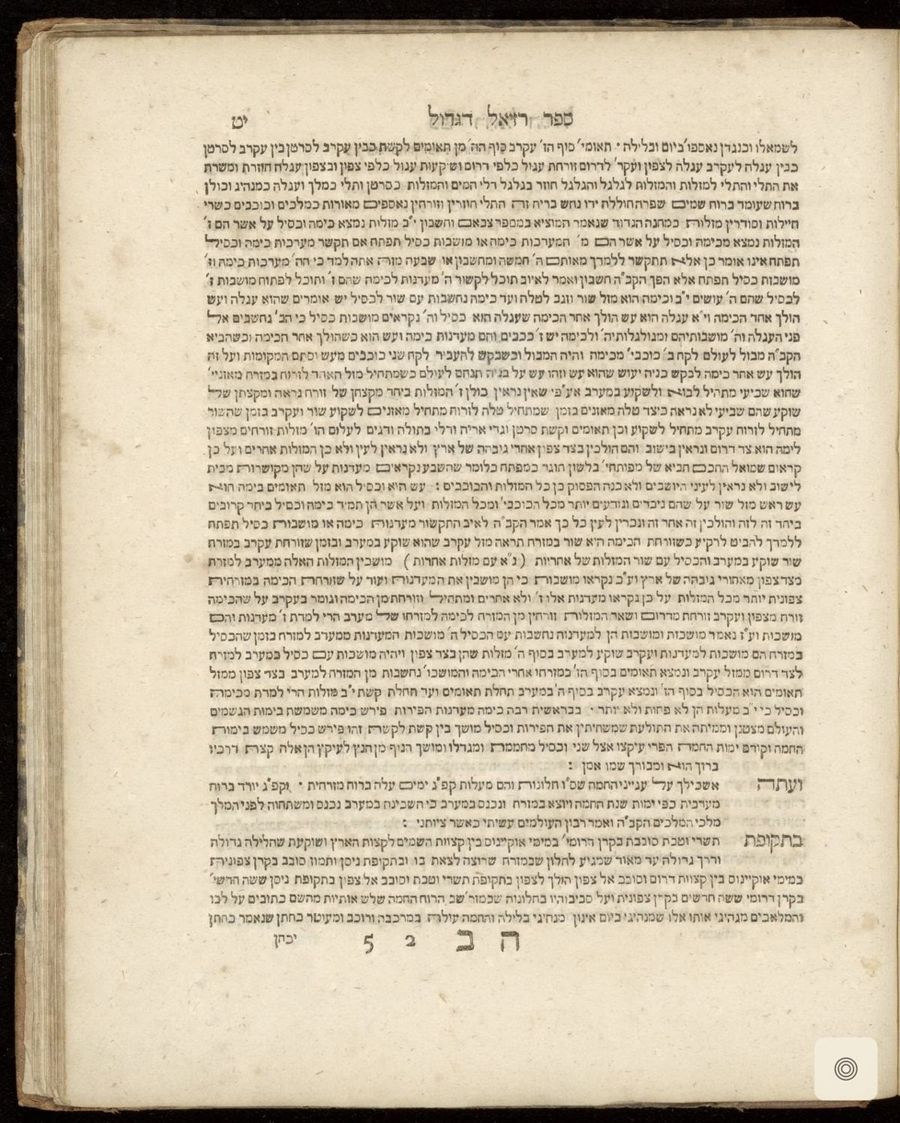
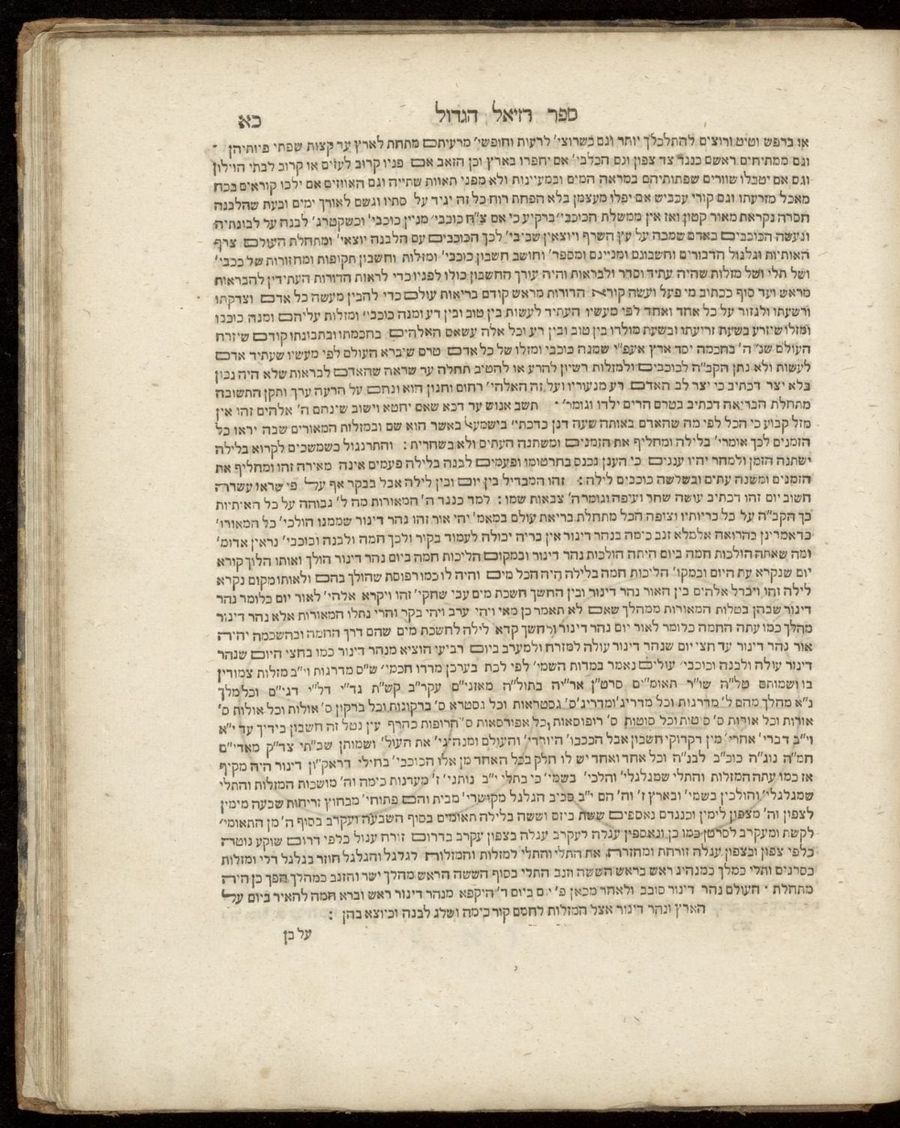
1701 printed page, scan page 47. Page image: Embassy of the Free Mind (Bibliotheca Philosophica Hermetica), Amsterdam, shelfmark Q, via Source Library. Public domain
Tap to open the scanPage image: Embassy of the Free Mind (Bibliotheca Philosophica Hermetica), Amsterdam, shelfmark Q, via Source Library. Public domain (CC PDM 1.0).
[p47] לשמאלו וכנגדן נאספו ביום ובלילה · תאומי' סוף הז' עקרב סוף הה' מן תאומים לקשת כבין עקרב לסרטן כבין עגלה לעקרב עגלה לצפון ועקר' לדרום זורחת עגול כלפי דרום ושוקעת עגול כלפי צפון ובצפון עגלה חוזרת ומשרת את התלי והתלי למזלות והמזלות לגלגל והגלגל חוזר בגלגל דלי המים והמזלות כסרטן ותלי כמלך ועגלה כמנהיג וכולן ברוח שעומד ברום שמים שפרה חוללה ידו נחש בריח וזה התלי חוזרין וזורחין נאספים מאורות כמלכים וכוכבים כשרי חיילות וסודרין מזלות כמחנה הנדוד שנאמר המוציא במספר צבאם וחשבון י"ב מזלות נמצא כימה וכסיל על אשר הם ז' המזלות נמצא מכימה וכסיל על אשר הם מ' המערכות כימה או מושבות כסיל תפתח אם תקשר מערכות כימה וכסיל תפתח אינו אומר כן אלא תתקשר ללמדך מאותם ה' חמשה ומחשבון או שבעה מזה אתה למד כי הה' מערכות כימה וז' מושבות כסיל תפתח אלא הפך הקב"ה חשבון ואמר לאיוב תוכל לקשור ה' מעדנות לכימה שהם ז' ותוכל לפתוח מושבות ז' לכסיל שהם ה' עושים י"ב וכימה הוא מזל שור וזנב לטלה ועד כימה נחשבות עם שור לכסיל יש אומרים שהוא עגלה ועש הולך אחר הכימה וי"א עגלה הוא עש הולך אחר הכימה שעגלה הוא כסיל וה' נקראים מושבות כסיל כי הב' נחשבים אל פני העגלה וה' מושבותיהם ומגולגלותיה' ולכימה יש ז' ככבים והם מעדנות כימה ועש הוא כשהולך אחר הכימה וכשהביא הקב"ה מבול לעולם לקח ב' כוכבי' מכימה והיה המבול וכשבקש להעביר לקח שני כוכבים מעש וסתם המקומות ועל זה הולך עש אחר כימה לבקש בניה שהוא עיוש וזהו עש על בניה תנחם כשמתחיל מזל האחד לזרוח במזרח מאזני' שהוא שביעי מתחיל לבוא ולשקוע במערב אע"פ שאין נראין כולן ז' המזלות ביחד מקצתן של זורח נראה ומקצתן של שוקע שהם שביעי לא נראה כיצד טלה מאזנים בזמן שמתחיל טלה לזרוח מתחיל מאזנים לשקוע שור ועקרב בזמן שהשור מתחיל לזרוח עקרב מתחיל לשקוע וכן תאומים וקשת סרטן וגדי אריה ודלי בתולה ודגים לעולם הו' מזלות זורחים מצפון לימה הוא צד דרום ונראין בישוב והם הולכין בצד צפון אחרי גיבהה של ארץ ולא נראין לעין ולא כן המזלות אחרים ועל כן קראום שמואל החכם חביא של מפותחי' בלשון חוגר כמפתח כלומר שהשבע נקראים מערנות על שהן מקושרות מבית לישוב ולא נראין לעיני היושבים ולא כנה הפסוק כן כל המזלות והכוכבים : עש הוא וכסיל הוא מזל תאומים כימה חוזר עש ראש מזל שור על שהם ניכרים ונודעים יותר מכל הכוכבי' ומכל המזלות ועל אשר הן תמיד כימה וכסיל ביחד קרובים ביחד זה לזה והולכין זה אחר זה ונכרין לעין כל כך אמר הקב"ה לאיוב התקשור מערנות כימה או מושבות כסיל תפתח ללמדך להבינו לרקיע כשזורחת הכימה היא שור במזרח תראה מזל עקרב שהוא שוקע במערב ובזמן שזורחת עקרב במזרח שור שוקע במערב והכסיל עם שור המזלות של אחריות (נ"א עם מזלות אחרות) מושכין המזלות האלה ממערב למזרח כצד צפון מאחורי גיבהה של ארץ וע"כ נקראו מושכות כי הן מושכין את המעדנות ועוד על שזורחת הכימה במזרחית צפונית יותר מכל המזלות על כן נקראו מעדנות אלו ז' ולא אחרים ומתחיל' וזורחת מן הכימה וגומר בעקרב על שהכימה זורח מצפון ועקרב זורחת מדרום ושאר המזלות זורחין מן המזרח לכימה למזרחו של מערב הרי למדת ז' מעדנות והם מושכות וע"ז נאמר מושכות ומושבות הן למעדנות נחשבות עם הכסיל ה' מושכות המעדנות ממערב למזרח בזמן שהכסיל במזרח הם מושכות למעדנות ועקרב שוקע למערב בסוף ה' מזלות שהן בצד צפון ויהיה מושכות עם כסיל במערב למזרח לצד דרום ממזל עקרב ונמצא תאומים בסוף הז' במזרחו אחרי הכימה והמושכו' נחשבות מן המזרח למערב בצד צפון ממזל תאומים הוא הכסיל בסוף הז' ונמצא עקרב בסוף ה' במערב תחלת תאומים ועד תחלת קשת י"ב מזלות הרי למדת מכימה וכסיל כי י"ב מעלות הן לא פחות ולא יותר · בבראשית רבה כימה מעדנות הפירות פירש כימה משמשת בימות הגשמים והעולם מצטנן וממיתה את התולעת שמשחיתין את הפירות וכסיל מושך בין קשת לקשרה זהו פירש בכסיל משמש בימות החמה וקודם ימות החמה הפרי עיקצו אצל שני וכסיל מחממת ומגדלו ומושך הנוף מן הנץ לעיקץ האלה קצרת דרכיו ברוך הוא ומבורך שמו אמן : ועתה אשכילך על ענייני החמה שס"ו חלונות והם מעלות קפ"ג ימים עלה ברוח מזרחית · וקפ"ג יורד ברוח מערבית כפי ימות שנת החמה ויוצא במזרח ונכנס במערב כי השכינה במערב נכנס ומשתחוה לפני המלך מלכי המלכים הקב"ה ואמר רבון העולמים עשיתי כאשר ציותני : בתקופת תשרי וטבת סובבת בקרן הדרומי' במימי אוקיינוס בין קצוות השמים לקצות הארץ ושוקעת שהלילה גדולה ודרך גדולה עד מאור שמגיע לחלון שבמזרח שרוצה לצאת בו ובתקופת ניסן ותמוז סובב בקרן צפונית במימי אוקיינוס בין קצוות דרום וסובב אל צפון הולך לצפון בתקופת תשרי וטבת וסובב אל צפון בתקופת ניסן ששה חדשי' בקרן דרומי ששה חדשים בקרן צפונית ועל סביבותיו בחלונותיו שבמזר' שב הרוח החמה שלש אותיות מהשם כתובים על לבו והמלאכים מגהיגי אותו אלו שמנהיגי ביום אינון מנהיגי בלילה והחמה עולה במרכבה ורוכב ומעוטר כחתן שנאמר כחתן [signature] ה ב · [catchword] יכין

English AI-assisted draft translation · not a scholarly edition

p47. AI-assisted draft translation, not a scholarly edition. Literal; uncertain readings [unclear], misprints [sic]. This page continues p48's catchword "on its left". Its numbers for the stars of Kimah and Kesil contradict each other, and they are given as printed. …on its left; and opposite them they are gathered by day and by night. Gemini is at the end of the seven, Scorpio at the end of the five: from Gemini to Sagittarius is as from Scorpio to Cancer, as from the Wagon to Scorpio. The Wagon is to the north and Scorpio to the south. [Scorpio] rises in a curve toward the south and sets in a curve toward the north; and in the north the Wagon turns and serves the Teli (the Dragon), the Teli [serves] the signs, the signs the sphere, and the sphere turns in the sphere [unclear]. Aquarius is the waters; the signs are like Cancer [unclear]; the Teli is like a king and the Wagon like a guide. All of them [move] by the wind that stands in the height of heaven: "By His wind the heavens are fair; His hand pierced the slant serpent" (Job 26:13), and that is the Teli. They turn and rise. The lights are gathered like kings, and the stars like captains of armies, and they set the signs in order like a marching camp, as it is said "who brings out their host by number" (Isa. 40:26). The count of the twelve signs is found [from] Kimah and Kesil, in that they are seven [and five; unclear]. "Can you bind the bonds (maʿadannot) of Kimah, or loose the bands (moshekhot) of Kesil?" (Job 38:31). If you bind the bonds of Kimah and Kesil, will you loose [them]? It does not say so, but "can you bind", to teach you from those five, five [unclear], and from the count of seven. From this you learn that the five are the bonds of Kimah and the seven the bands of Kesil that you loose. But the Holy One, blessed be He, reversed the count and said to Job: can you bind five bonds for Kimah, which are seven, and can you loose seven bands for Kesil, which are five? Together they make twelve. Kimah is the sign of Taurus and the tail of Aries; up to Kimah they are counted with Taurus. As for Kesil, some say it is the Wagon, and ʿAsh goes after Kimah; others say the Wagon is ʿAsh, which goes after Kimah, and the Wagon [sic] is Kesil. Five are called "the bands of Kesil", because two are counted before the Wagon and five are its seats and its revolutions. Kimah has seven stars, and they are "the bonds of Kimah". ʿAsh is so called because it goes after Kimah. When the Holy One, blessed be He, brought the Flood on the world, He took two stars from Kimah and the Flood came; and when He sought to end it, He took two stars from ʿAsh and stopped up the places. For this reason ʿAsh goes after Kimah, seeking her children, for it is ʿAyush; this is "or can you guide ʿAyish with her children?" (Job 38:32), read as "comfort her" [unclear: תנחם]. When one sign begins to rise in the east, Libra, which is the seventh, begins to come and set in the west. Not all seven signs are seen together: part of the rising one is seen, and part of the setting one, which is the seventh, is not seen. How so? Aries and Libra: when Aries begins to rise, Libra begins to set. Taurus and Scorpio: when Taurus begins to rise, Scorpio begins to set. Likewise Gemini and Sagittarius, Cancer and Capricorn, Leo and Aquarius, Virgo and Pisces. Six signs always rise from the north toward the sea [ימה, i.e. west; unclear] [or] the south side and are seen in the inhabited world; and those that go on the north side behind the height of the earth are not seen by the eye. It is not so with the other signs. Therefore Samuel the Wise called them "the hiding-place [unclear: חביא] of the open ones", in the language of a girdle like a key. That is, the seven are called "bonds" because they are bound from inside toward the inhabited world and are not seen by the inhabitants. The verse did not name all the signs and stars in this way. ʿAsh and Kesil are the sign of Gemini, [and] Kimah returns [unclear]; ʿAsh is the head of the sign of Taurus. [They are named] because they are more recognised and known than all the stars and all the signs, and because Kimah and Kesil are always near one another, go one after the other, and are so plain to the eye. Therefore the Holy One, blessed be He, said to Job "can you bind the bonds of Kimah, or loose the bands of Kesil?", to teach you to understand the firmament. When Kimah, which is Taurus, rises in the east, you will see the sign of Scorpio setting in the west; and when Scorpio rises in the east, Taurus sets in the west. Kesil, with Taurus and the signs after it (another version: with other signs), draws these signs from west to east on the north side, behind the height of the earth; therefore they are called "bands" (moshekhot), for they draw the bonds. Further, because Kimah rises in the north-east more than all the signs, these seven, and no others, are called "bonds". It begins and rises from Kimah and ends in Scorpio, because Kimah rises from the north and Scorpio from the south, and the other signs rise from the east, from Kimah eastward of the west [unclear]. So you have learned the seven bonds, and they are bands. Of this it is said that the bands and the seats are counted as bonds with Kesil. Five bands draw the bonds from west to east. When Kesil is in the east, they are bands to the bonds, and Scorpio sets in the west at the end of five signs, which are on the north side. The bands, with Kesil, run from west to east on the south side from the sign of Scorpio, and Gemini is found at the end of the seven in its east, after Kimah. The bands are counted from east to west on the north side from the sign of Gemini, which is Kesil at the end of the seven, and Scorpio is found at the end of the five in the west. From the beginning of Gemini to the beginning of Sagittarius are twelve signs [as printed]. So you have learned from Kimah and Kesil that there are twelve degrees (maʿalot) [sic, for "signs"], no fewer and no more. In Bereshit Rabbah: "Kimah, the delicacies [maʿadannot] of the fruits." It explains that Kimah serves in the days of rain: the world grows cool and it kills the worm that destroys the fruits. "Kesil draws [moshekh] between the stalk and its knot" [unclear]: this explains that Kesil serves in the days of summer. Before the summer the fruit's stalk is beside the second [unclear: אצל שני], and Kesil warms it and makes it grow, and draws the branch from the bud to the stalk. "Lo, these are but the outskirts of His ways" (Job 26:14). Blessed is He, and blessed is His Name, Amen. [Display word] AND NOW I will instruct you about the matters of the sun. It has 366 windows, and they are degrees. For 183 days it goes up through the east wind [quarter], and for 183 it goes down through the west wind, according to the days of the solar year. It goes out in the east and enters in the west, for the Shekhinah is in the west. It enters and bows down before the King of the kings of kings, the Holy One, blessed be He, and says: "Master of the worlds, I have done as You commanded me." [Display word] AT THE SEASON of Tishri and Tevet it circles in the southern corner, in the waters of Oceanus, between the ends of heaven and the ends of the earth, and sets. The night is long and the road long, until the light reaches the window in the east by which it wishes to go out. At the season of Nisan and Tammuz it circles in the northern corner, in the waters of Oceanus between the ends of the south, and turns toward the north. [It] goes northward at the season of Tishri and Tevet and turns toward the north at the season of Nisan [as printed]: six months in the southern corner and six months in the northern corner, and about its circuits in its windows in the east. The sun's wind turns [unclear]. Three letters of the Name are written on its heart, and angels guide it; those that guide it by day are not those that guide it by night. The sun goes up in a chariot and rides crowned like a bridegroom, as it is said "like a bridegroom" (Ps. 19:6) [Signature] ה ב [i.e. gathering mark] · [Catchword] he will prepare (יכין)
Scripture on this page · 6 references with the KJV text

References are given as printed, in Hebrew chapter and verse numbering. Where the KJV numbers the verse differently (mostly Psalms, which count the title as verse 1 in Hebrew), the KJV reference is shown. KJV text: King James Version (1769 text), public domain; text from github.com/thiagobodruk/bible (en_kjv.json), fetched 28 Oct 2026. Genesis, Exodus and Leviticus also show the Gutenberg Bible on this site (/gb/): Latin Vulgate in Gutenberg spelling with the Douay-Rheims English.

  • Job 26:13
    KJV: By his spirit he hath garnished the heavens; his hand hath formed the crooked serpent.
  • Isaiah 40:26
    KJV: Lift up your eyes on high, and behold who hath created these things , that bringeth out their host by number: he calleth them all by names by the greatness of his might, for that he is strong in power; not one faileth.
  • Job 38:31
    KJV: Canst thou bind the sweet influences of Pleiades, or loose the bands of Orion?
  • Job 38:32
    KJV: Canst thou bring forth Mazzaroth in his season? or canst thou guide Arcturus with his sons?
  • Job 26:14
    KJV: Lo, these are parts of his ways: but how little a portion is heard of him? but the thunder of his power who can understand?
  • Psalms 19:6 Hebrew numbering; KJV Psalms 19:5
    KJV: Which is as a bridegroom coming out of his chamber, and rejoiceth as a strong man to run a race.

Hebrew as printed, read from the scan
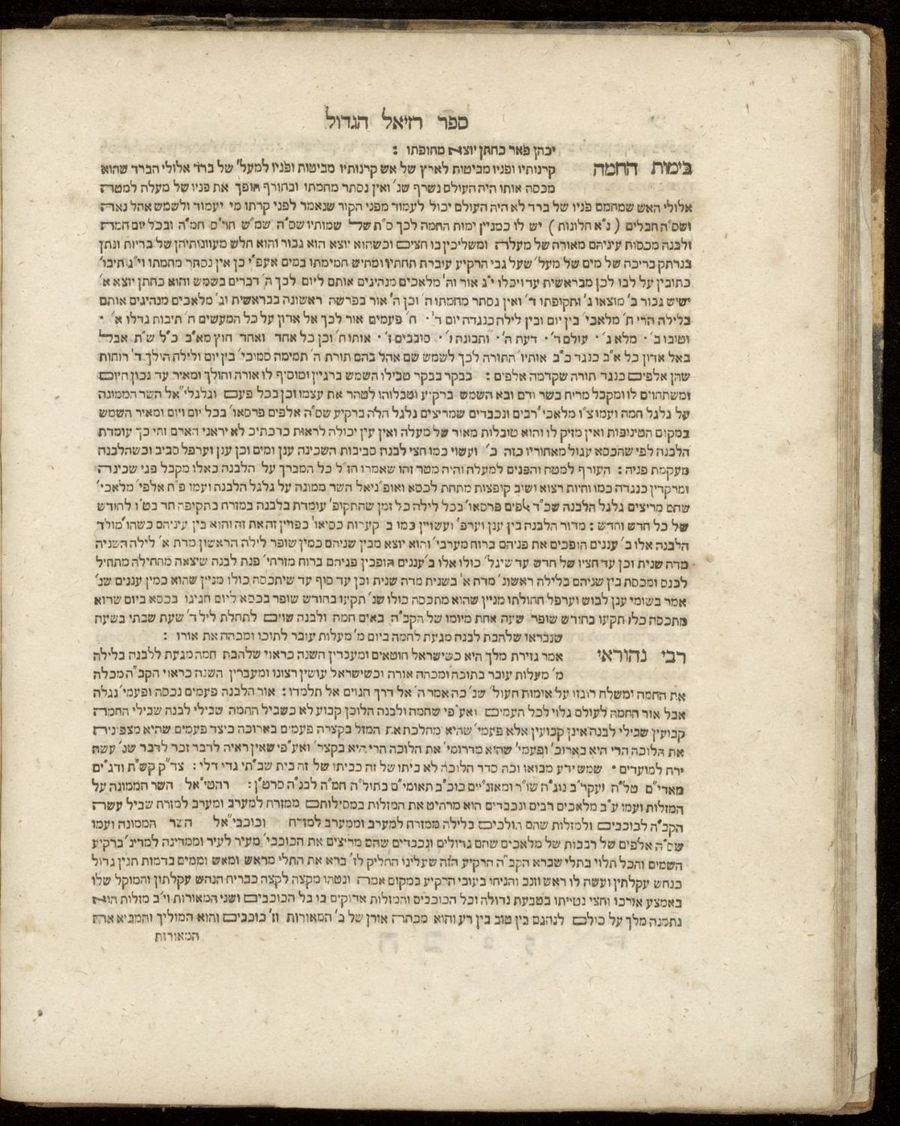
1701 printed page, scan page 50. Page image: Embassy of the Free Mind (Bibliotheca Philosophica Hermetica), Amsterdam, shelfmark Q, via Source Library. Public domain
Tap to open the scanPage image: Embassy of the Free Mind (Bibliotheca Philosophica Hermetica), Amsterdam, shelfmark Q, via Source Library. Public domain (CC PDM 1.0).
[p50] יכהן פאר כחתן יוצא מחופתו : בימות החמה קרנותיו ופניו מביטות לארץ של אש קרנותיו מביטות ופניו למעל' של ברד אלולי הברד שהוא מכסה אותו היה העולם נשרף שנ' ואין נסתר מחמתו ובחורף הופך את פניו של מעלה למטה אלולי האש שמחמם פניו של ברד לא היה העולם יכול לעמוד מפני הקור שנאמר לפני קרתו מי יעמוד ולשמש אהל נארה ושס"ה חבלים (נ"א חלונות) יש לו כמניין ימות החמה לכך ס"ת של שמותיו שס"ה שמ"ש חר"ס חמ"ה ובכל יום חמה ולבנה מכסות עיניהם מאורה של מעלה ומשליכין בו חצים וכשהוא יוצא הוא גבור והוא חלש מעוונותיהן של בריות ונתן בנרתק בריכה של מים של מעל' שעל גבי הרקיע עוברת תחתיו ומתיש חמימתו במים אעפ"י כן אין נסתר מחמתו וי"ג תיבו' כתובין על לבו לכן מבראשית עד ויכלו י"ג אור וה' מלאכים מנהיגים אותם ליום לכך ה' דברים בשמש והוא כחתן יוצא א' ישיש גבור ב' מוצאו ג' ותקופתו ד' ואין נסתר מחמתו ה' וכן ה' אור בפרשה ראשונה בבראשית וג' מלאכים מנהיגים אותם בלילה הרי ח' מלאכי' בין יום ובין לילה כנגדה יום ד' · ח' פעמים אור לכך אל ארון על כל המעשים ח' תיבות גדלו א' וטובו ב' · מלא ג' · עולם ד' · דעת ה' · ותבונה ו' · סובבים ז' · אותו ח' וכן כל אחד ואחד חוץ מא"ב כ"ל ש"ת אבל באל אדון כל א"ב כנגד כ"ב אותיו' התורה לכך לשמש שם אהל בהם תורת ה' תמימה סמוכי' בין יום ולילה הולך ד' רוחות שהן אלפים כנגד תורה שקדמה אלפים : בבקר בבקר טבילו השמש ברגיין ומוסיף לו אורה והולך ומאיר עד נכון היום ומשתחוים לו ומקבל מריח בשר ודם ובא השמש ברקיע וטבלוהו לטהר את עצמו וכן בכל פעם וגלגלי' אל השר הממונה על גלגל חמה ועמו צ"ו מלאכי' רבים ונכברים שמריצים גלגל הלה ברקיע שס"ה אלפים פרסאו' בכל יום ויום ומאיר השמש במקום הטינופות ואין מזיק לו והוא טובלות מאור של מעלה ואין עין יכולה לראות כרכתיב לא יראני האדם וחי כך עומדת [line at strip boundary — see scan] הלבנה לפי שהכסא עגול מאחוריו כזה כ' ועשוי כמו חצי לבנה סביבות השכינה ענן ומים וכן ענן וערפל סביב וכשהלבנה מעקמת פניה : העורף למטה והפנים למעלה והיה מטר זהו שאמרו חז"ל כל המברך על הלבנה כאלו מקבל פני שכינה ומרקדין כנגדה כמו וחיות רצוא ושוב קופצות מתחת לכסא ואופניאל השר ממונה על גלגל הלבנה ועמו פ"ח אלפי' מלאכי' שהם מריצים גלגל הלבנה שכ"ד אלפים פרסאו' בכל לילה כל זמן שהתקופ' עומדת בלבנה במזרח בתקופה חר בט"ו לחודש של כל חדש וחדש : מדור הלבנה בין ענן וערפ' ועשוין כמו ב' קערות כסיאו' כפויין זה את זה והוא בין עיניהם כשהו' מולד הלבנה אלו ב' עננים הופכים את פניהם ברוח מערבי' והוא יוצא מבין שניהם כמין שופר לילה הראשון מדת א' לילה השניה מדה שנית וכן עד חציו של חדש עד שיגל' כולו אלו ב' עננים הופכין פניהם ברוח מזרחי' פנת לבנה שיצאה מתחילה מתחיל לכנס ומכסת בין שניהם בלילה ראשונ' מדה א' בשנית מדה שנית וכן עד סוף עד שיתכסה כולו מניין שהוא כמין עננים שנ' אמר בשומי ענן לבוש וערפל חחולתו מניין שהוא מתחיל שהוא מתכסה כולו שנ' תקעו בחודש שופר בכסא ליום חגינו בכסא ביום שרוא מתכסה כלו תקעו בחורש שופר שעה אחת מיומו של הקב"ה באים חמה ולבנה שוים לתחלת ליל ד' שעת שבתי בשעה שנבראו שלהבת לבנה מגעת לחמה ביום מ' מעלות עובר לתוכו ומכהה את אורו : רבי נהוראי אמר גזירת מלך היא כשישראל חוטאים ומעברין השנה כראוי שלהבת חמה מגעת ללבנה בלילה מ' מעלות עובר בתוכה ומכהה אורה וכשישראל עושין רצונו ומעברין השנה כראוי הקב"ה המכלה את החמה וממשלה רוגזו על אומות העול' שנ' כה אמר ה' אל דרך הגוים אל תלמדו : אור הלבנה פעמים נכסה ופעמי' נגלה אבל אור החמה לעולם גלוי לכל העמים ואע"פ שחמה ולבנה הלוכן קבוע לא כשביל החמה שבילי לבנה שבילי החמה קבועין שבילי לבנה אינן קבועין אלא פעמי' שהיא מהלכת את המזל בקצרה פעמים בארוכה כיצד פעמים שהיא מצפונית את הלוכה הרי היא בארוכ' ופעמי' שהיא מדרומי' את הלוכה הרי היא בקצר' ואע"פ שאין ראיה לדבר זכר לדבר שנ' עשה ירח למועדים · שמש ידע מבואו וכה סדר הלוכה לא כיתו של זה כביתו של זה בית שב"תי גדי דלי : צד"ק קש"ת ודג"ים מאד"ים טל"ה ועקר"ב נוג"ה שו"ר ומאזנ"ים כוכ"ב תאומי"ם בתול"ה חמ"ה לבנ"ה סרט"ן : רהטיאל השר הממונה על המזלות ועמו ע"ב מלאכים רבים ונכבדים הוא מרהיט את המזלות במסילותם ממזרח למערב ומערב למזרח שביל עשה הקב"ה לכוכבים ולמזלות שהם הולכים בלילה ממזרח למערב וממערב למזרח וכוכבי"אל השר הממונה ועמו שס"ה אלפים של רבבות של מלאכים שהם גדולים ונכבדים שהם מריצים את הכוכבי' מעיר לעיר וממדינה למדינ' ברקיע השמים והכל תלוי בתלי שברא הקב"ה הרקיע הזה שעלינו החליק לז' ברא את התלי מראש ומאש וממים בדמות תנין גדול כנחש עקלתון ועשה לו ראש וזנב והניחו בעובי הרקיע במקום אמרה ונטהו מקצה לקצה כבריח הנחש עקלתון והמוקל שלו באמצע ארכו וחצי נטייתו בטבעת גדולה וכל הכוכבים והמזלות אדוקים בו כל הכוכבים ושני המאורות וי"ב מזלות הוא נתמנה מלך על כולם לנהגם בין טוב בין רע והוא מכהה אורן של ב' המאורות וז' כוכבים והוא המוליך והמביא את [catchword] המאורות

English AI-assisted draft translation · not a scholarly edition

p50. AI-assisted draft translation, not a scholarly edition. Literal; uncertain readings [unclear], misprints [sic]. One line falls at a strip boundary of the working images and is marked "see scan". Continues p47's catchword "he will prepare (יכין)". "…as a bridegroom decks himself [yekhahen] with a garland" (Isa. 61:10), "as a bridegroom coming out of his chamber" (Ps. 19:6). [Display words] IN THE DAYS OF SUMMER its horns and its face look toward the earth: its horns, which are of fire, look [down], and its face, which is of hail, looks upward. Were it not for the hail that covers it, the world would be burned, as it is said "and there is nothing hidden from its heat" (Ps. 19:7). In winter it turns its upper face downward. Were it not for the fire that warms its face of hail, the world could not endure because of the cold, as it is said "who can stand before His cold?" (Ps. 147:17). "In them He has set a tent for the sun" (Ps. 19:5). And it has 365 cords (another version: windows), as the number of the days of the solar year. Therefore the final letters of its names add up to 365: shemesh, ḥeres, ḥammah. Every day the sun and the moon cover their eyes from the light above, and [the hosts] shoot arrows at it. When it goes out it is mighty, and it grows weak from the iniquities of creatures. It is set in a sheath of a pool of the upper waters, which are on the back of the firmament and pass beneath it, and this weakens its heat in the water; even so, "nothing is hidden from its heat". Thirteen words are written on its heart; therefore from Bereshit to Vayekhulu "light" [occurs] thirteen [times, as printed]. Five angels guide it by day; therefore five things [are said] of the sun: it is like a bridegroom going out (1), "it rejoices as a mighty man" (2), "its going forth" (3), "and its circuit" (4), "and nothing is hidden from its heat" (5). Likewise "light" five times in the first section of Bereshit. Three angels guide it by night, making eight angels between day and night, corresponding to the fourth day. "Light" [occurs] eight times; therefore "El Adon over all the works" has eight words: "great" (1), "and good" (2), "full" (3), "world" (4), "knowledge" (5), "and understanding" (6), "surround" (7), "Him" (8). And so each one, except the alphabetic ones, kol and sh-t [unclear]. But in "El Adon" the whole alphabet [appears], corresponding to the 22 letters of the Torah; therefore "for the sun He set a tent in them" is [followed by] "the Torah of the LORD is perfect" (Ps. 19:8). Joined between day and night, it goes to the four winds, which are two thousand [years], corresponding to the Torah, which preceded [the world] by two thousand [years]. Morning by morning they immerse the sun in the river Rigyon [of fire] and add light to it, and it goes on shining "until the perfect day" (Prov. 4:18). And they bow down to it, and it receives the smell of flesh and blood. The sun comes into the firmament and they immerse it so that it purifies itself, and so every time. Galgalli'el is the prince appointed over the sphere of the sun, and with him are 96 great and honoured angels who make that sphere run in the firmament 365 thousand parasangs every day. The sun shines on places of filth and is not harmed. It is immersed in the light above, and no eye can look [on that light], as it is written "for no man shall see Me and live" (Ex. 33:20). So stands [see scan — line at strip boundary] …the moon, because the Throne is round behind like this [letter] kaf (כ), made like a half-moon, and round the Shekhinah are cloud and water; likewise "clouds and thick darkness are round about Him" (Ps. 97:2). When the moon bends its face, the nape down and the face up, there will be rain. This is what our sages of blessed memory said: whoever blesses the moon is as though he received the face of the Shekhinah. And [people] dance toward it, like "and the living creatures ran and returned" (Ezek. 1:14), leaping beneath the Throne. Ofanni'el is the prince appointed over the sphere of the moon, and with him are 88 thousand angels who make the moon's sphere run 324 thousand parasangs every night, as long as the season stands with the moon in the east, at the season [unclear: חר] on the 15th of each and every month. The dwelling of the moon is between cloud and thick darkness, made like two silver bowls turned over one another, and it is between them. At the birth of the moon these two clouds turn their faces to the west wind, and it comes out between the two of them like a horn: the first night one measure, the second night a second measure, and so until the middle of the month, until it is wholly revealed. [Then] these two clouds turn their faces to the east wind, and the corner of the moon that came out first begins to enter, and it is covered between the two of them: on the first night one measure, on the second a second measure, and so to the end, until it is wholly covered. How do we know that it is like clouds? It is said "when I made the cloud its garment and thick darkness its swaddling band" (Job 38:9). How do we know that it is wholly covered? It is said "blow the shofar at the new moon, at the covered time (bakkeseh), on our feast day" (Ps. 81:4): at the covered time, on the day when it is wholly covered. "Blow the shofar at the new moon." For one hour of the day of the Holy One, blessed be He, the sun and moon come equal at the beginning of the night of the fourth [day], the hour of Shabbetai, at the hour they were created. When the moon's flame reaches the sun by day at 40 degrees, it passes into it and dims its light. [Display words] RABBI NEHORAI said: it is a decree of the King. When Israel sin and do not intercalate the year properly, the flame of the sun reaches the moon at night at 40 degrees, passes into it and dims its light. When Israel do His will and intercalate the year properly, the Holy One, blessed be He, dims [unclear: המכלה] the sun and [turns] His anger on the nations of the world, as it is said "Thus says the LORD: learn not the way of the nations, [and be not dismayed at the signs of heaven]" (Jer. 10:2). The moon's light is sometimes covered and sometimes revealed, but the sun's light is always revealed to all peoples. Although the courses of sun and moon are fixed, the moon's paths are not like the sun's: the sun's paths are fixed, and the moon's paths are not, but sometimes it travels the sign by a short way and sometimes by a long way. How so? When it makes its course northerly, it is long; when it makes its course southerly, it is short. Although there is no proof of the matter, there is a hint of it, as it is said "He made the moon for seasons; the sun knows its going down" (Ps. 104:19). This is the order of their course; the house of one is not like the house of another. The house of Shabbetai: Capricorn and Aquarius. Tsedeq: Sagittarius and Pisces. Ma'adim: Aries and Scorpio. Nogah: Taurus and Libra. Kokhav: Gemini and Virgo. Ḥammah: [Leo; omitted in print, sic]. Levanah: Cancer. Rahaṭi'el is the prince appointed over the signs, and with him are 72 great and honoured angels. He makes the signs run (marhiṭ) in their paths from east to west and from west to east. The Holy One, blessed be He, made a path for the stars and the signs, which go by night from east to west and from west to east. Kokhavi'el is the prince appointed [over the stars], and with him are 365 thousand myriads of great and honoured angels, who make the stars run from city to city and from province to province in the firmament of heaven. And everything hangs on the Teli. When the Holy One, blessed be He, created this firmament above us, He made it smooth for the seven [unclear: החליק לז']. He created the Teli from the beginning [unclear: מראש], of fire and of water, in the likeness of a great dragon (tannin), like the crooked serpent. He made it a head and a tail and set it in the thickness of the firmament in the place [unclear: אמרה], and stretched it from end to end like a bar — the crooked serpent. Its knot [unclear: והמוקל] is in the middle of its length, and half its extent is in a great ring. All the stars and the signs are fastened to it: all the stars, the two lights and the twelve signs. It was appointed king over all of them, to guide them for good or for ill. It dims the light of the two lights and the seven stars, and it leads and brings back the [Catchword] the lights (המאורות)
Scripture on this page · 14 references with the KJV text

References are given as printed, in Hebrew chapter and verse numbering. Where the KJV numbers the verse differently (mostly Psalms, which count the title as verse 1 in Hebrew), the KJV reference is shown. KJV text: King James Version (1769 text), public domain; text from github.com/thiagobodruk/bible (en_kjv.json), fetched 28 Oct 2026. Genesis, Exodus and Leviticus also show the Gutenberg Bible on this site (/gb/): Latin Vulgate in Gutenberg spelling with the Douay-Rheims English.

  • Isaiah 61:10
    KJV: I will greatly rejoice in the LORD , my soul shall be joyful in my God; for he hath clothed me with the garments of salvation, he hath covered me with the robe of righteousness, as a bridegroom decketh himself with ornaments, and as a bride adorneth herself with her jewels.
  • Psalms 19:6 Hebrew numbering; KJV Psalms 19:5
    KJV: Which is as a bridegroom coming out of his chamber, and rejoiceth as a strong man to run a race.
  • Psalms 19:7 Hebrew numbering; KJV Psalms 19:6
    KJV: His going forth is from the end of the heaven, and his circuit unto the ends of it: and there is nothing hid from the heat thereof.
  • Psalms 147:17
    KJV: He casteth forth his ice like morsels: who can stand before his cold?
  • Psalms 19:5 Hebrew numbering; KJV Psalms 19:4
    KJV: Their line is gone out through all the earth, and their words to the end of the world. In them hath he set a tabernacle for the sun,
  • Psalms 19:8 Hebrew numbering; KJV Psalms 19:7
    KJV: The law of the LORD is perfect, converting the soul: the testimony of the LORD is sure, making wise the simple.
  • Proverbs 4:18
    KJV: But the path of the just is as the shining light, that shineth more and more unto the perfect day.
  • Exodus 33:20
    KJV: And he said, Thou canst not see my face: for there shall no man see me, and live.
    Gutenberg Bible, leaf 045v: Rursumque ait: Non poteris videre faciem meam: non enim videbit me homo et vivet. — And again he said: Thou canst not see my face: for man shall not see me, and live.
  • Psalms 97:2
    KJV: Clouds and darkness are round about him: righteousness and judgment are the habitation of his throne.
  • Ezekiel 1:14
    KJV: And the living creatures ran and returned as the appearance of a flash of lightning.
  • Job 38:9
    KJV: When I made the cloud the garment thereof, and thick darkness a swaddlingband for it,
  • Psalms 81:4 Hebrew numbering; KJV Psalms 81:3
    KJV: Blow up the trumpet in the new moon, in the time appointed, on our solemn feast day.
  • Jeremiah 10:2
    KJV: Thus saith the LORD , Learn not the way of the heathen, and be not dismayed at the signs of heaven; for the heathen are dismayed at them.
  • Psalms 104:19
    KJV: He appointed the moon for seasons: the sun knoweth his going down.

Hebrew as printed, read from the scan
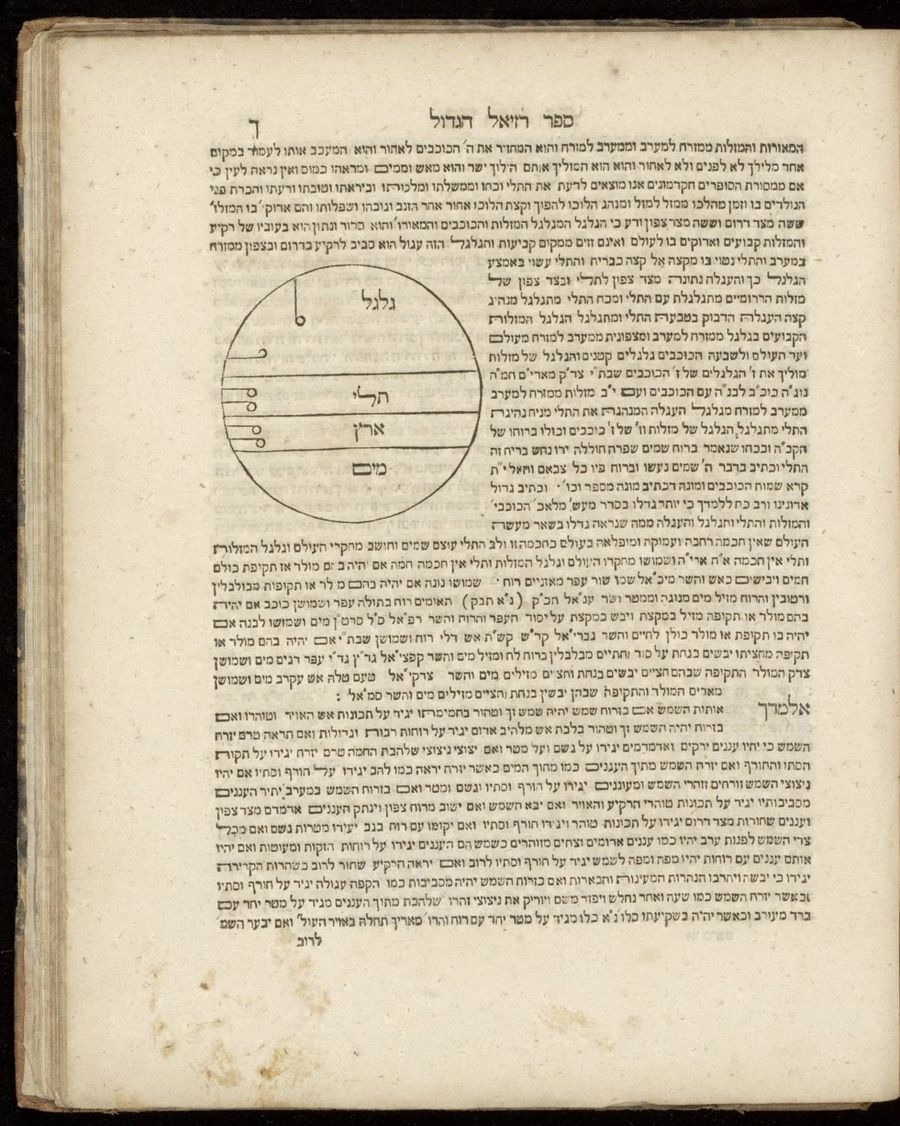
1701 printed page, scan page 49. Page image: Embassy of the Free Mind (Bibliotheca Philosophica Hermetica), Amsterdam, shelfmark Q, via Source Library. Public domain
Tap to open the scanPage image: Embassy of the Free Mind (Bibliotheca Philosophica Hermetica), Amsterdam, shelfmark Q, via Source Library. Public domain (CC PDM 1.0).
[p49] המאורות והמזלות ממזרח למערב וממערב למזרח והוא המחזיר את ה' הכוכבים לאחור והוא המעכב אותו לעמוד במקום אחד מלילך לא לפנים ולא לאחור והוא הוא המוליך אותם הילוך ישר והוא מאש וממים ומראהו כמוס ואין נראה לעין כי אם ממסורת הסופרים הקדמונים אנו מוצאים לדעת את התלי וכחו וממשלתו ומלכותו וביראתו וטובתו ורעתו והכרת פני הנולדים בו וזמן מהלכו ממזל למזל ומנהג הלוכו להפוך וקצת הלוכו אחור אחר הזנב וגובהו ושפלותו והם אדוקי' בו המזלו' ששה מצד דרום וששה מצד צפון ודע כי הגלגל המגלגל המזלות והכוכבים והמאורו' והוא סרור ונתון הוא בעוביו של רקיע והמזלות קבועים ואדוקים בו לעולם ואינם זזים ממקום קביעות והגלגל הזה עגול הוא סביב לרקיע בדרום ובצפון ממזרח במערב והתלי נטוי בו מקצה אל קצה כבריח והתלי עשוי באמצע הגלגל כך והעגלה נתונה מצד צפון לתלי ובצד צפון של מזלות הדרומיים מתגלגלת עם התלי וככח התלי מתגלגל מנהיג קצה העגלה הדבוק בטבעת התלי ומתגלגל הגלגל המזלות הקבועים בגלגל ממזרח למערב ומצפונית ממערב למזרח מעולם ועד העולם ולשבעה הכוכבים גלגלים קטנים והגלגל של מזלות מוליך את ז' הגלגלים של ז' הכוכבים שבת"י צד"ק מאדי"ם חמ"ה נוג"ה כוכ"ב לבנ"ה עם הכוכבים ועם י"ב מזלות ממזרח למערב ממערב למזרח מגלגל העגלה המנהגת את התלי מניח נהיגת התלי מתגלגל הגלגל של מזלות וז' של ז' כוכבים וכולו ברוחו של הקב"ה ובכחו שנאמר ברוח שמים שפרה חוללה ידו נחש בריח זה התלי וכתיב בדבר ה' שמים נעשו וברוח פיו כל צבאם והאלי"ת קרא שמות הכוכבים ומונה דכתיב מונה מספר וכו' · וכתיב גדול ארונינו ורב כח ללמדך כי יותר גדלו בסדר מעש' מלאכ' הכוכבי' והמזלות והתלי והגלגל והעגלה ממה שנראה גדלו בשאר מעשה העולם שאין חכמה רחבה ועמוקה ומופלאה בעולם כחכמה זו ולב התלי עוצם שמים וחושב מחקרי העולם וגלגל המזלות ותלי אין חכמה א"ח ארי"ה ושמושו מחקרו העולם וגלגל המזלות ותלי אין חכמה חמה אם יהיה בם מולד אז תקופת כולם חמים ויבישים כאש והשר מיכ"אל שכו שור עפר מאזניים רוח · שמושו נוגה אם יהיה בהם מ"לר או תקופת מבולבלין ורטובין והרוח מזיל מים מנוגה וממטר ושר ענ"אל חכ"ק (נ"א תבק) תאומים רוח בתולה עפר ושמושן כוכב אם יהיה בהם מולד או תקופה מזיל במקצת ויבש במקצת על יסור העפר והרוח והשר רפ"אל ס"ל סרט"ן מים ושמושו לבנה אם יהיה בו תקופת או מולד כולן לחיים והשר גבריאל קר"ש קש"ת אש דלי רוח ושמושן שבת"י אם יהיה בהם מולד או תקופה מחציתו יבשים בנחת על סוד ותחים מבלבלין ברוח לח ומזיל מים והשר קפצי"אל גר"ץ גד"י עפר דגים מים ושמושן צדק המולד התקופה שבהם חציים יבשים בנחת וחציים מזילים מים והשר צדקי"אל טעם טלה אש עקרב מים ושמושן מארים המולד והתקופה שבהן יבשין בנחת והציים מזילים מים והשר סמ"אל : אלמדך אותות השמש אם כזרוח שמש יהיה שמש זך וטהור בחמימותו יגיד על תכונות אש האויר וטוהרו ואם בזרוח יהיה השמש זך וטהור בלבת אש מלהיב אדום יגיד על רוחות רבות וגדולות ואם תראה טרם יזרח השמש כי יהיו עננים ירקים ואדמדמים יגידו על גשם ועל מטר ואם יצוצי ניצוצי שלהבת החמה טרם יזרח יגידו על תקופת הסתיו והחורף ואם יורה השמש מתוך העננים כמו מחוץ המים כאשר יורח יראה כמו להב יגידו על חורף וסתיו אם יהיו ניצוצי השמש זורחים וזוהרי השמש ומעוננים יגידו על חורף וסתיו וגשם ומטר ואם בזרוח השמש במערב יתיר העננים מסביבותיו יגיד על תכונות טוהרי הרקיע והאויר ואם יבא השמש ואם ישוב מרוח צפון וינתק העננים אדמדם מצד צפון ועננים שחורות מצד דרום יגידו על תכונות טוהר ויגידו חורף וסתיו ואם יקומו עם רוח בגב יעירו מטרות גשם ואם מכל צדי השמש לפנות ערב יהיו כמו עננים אדומים וצחים מזוהרים כשמש הם העננים יגידו על רוחות הזקות ומעוטות ואם יהיו אותם עננים עם רוחות יהיו מפה ומפה לשמש יגיד על חורף וסתיו לרוב ואם יראה הרקיע שחור לרוב כשחרות הקדירה יגידו כי יבשת ויחרבו הנהרות המעינות והבארות ואם כזרוח השמש יהיה מסביבות כמו הקפה עגולה יגיד על חורף וסתיו ובאשר יזרח השמש כמו שעה ואחר נחלש ויפזר משם ויוריק את ניצוצי זהרו שלהבת מתוך העננים מגיד על מטר יחד עם ברד מעורב וכאשר יהיה בשקיעתו סלו נ"א כלו מגיד על מטר יחד עם רוח וזהרו מאריך תחלה באויר העול' ואם יבער השמ' [catchword] לרוב [diagram, inset in text — see scan: a circle labelled גלגל, with horizontal bands labelled תלי, ארץ, מים, and small loops on the left edge]

English AI-assisted draft translation · not a scholarly edition

p49. AI-assisted draft translation, not a scholarly edition. Literal; uncertain readings [unclear], misprints [sic]. Continues p50's catchword "the lights". There is a small diagram inset at the right of the upper text: a circle labelled galgal (sphere), with bands labelled Teli, Erets (earth) and Mayim (water) — see scan. …the lights and the signs from east to west and from west to east. It is what turns the five stars [planets] backward, and what holds one back from standing in one place, from going either forward or backward; and it is what leads them in a straight course. It is of fire and of water, and its appearance is hidden and not visible to the eye. Only from the tradition of the ancient scribes do we find the means to know the Teli: its power, its dominion and its kingship, its fear, its good and its evil, the recognition of the faces of those born under it, the time of its travel from sign to sign, the manner of its course in turning, part of its course going backward after the tail, and its height and lowness. The signs are fastened to it, six on the south side and six on the north side. And know that the sphere (galgal) that rolls the signs, the stars and the lights is set [unclear: סרור] in the thickness of the firmament. The signs are fixed and fastened in it for ever and do not move from their fixed place. This sphere is round about the firmament, in the south and in the north, from east to west. The Teli is stretched in it from end to end like a bar, and the Teli is made in the middle of the sphere thus [see diagram]. The Wagon is set on the north side of the Teli, and on the north side of the southern signs it rolls with the Teli. By the Teli's power the end of the Wagon, which is fastened in the Teli's ring, rolls and guides [it], and the sphere of the signs fixed in it rolls from east to west and, northerly, from west to east, from everlasting to everlasting. The seven stars have small spheres, and the sphere of the signs carries the seven spheres of the seven stars — Shabbetai, Tsedeq, Ma'adim, Ḥammah, Nogah, Kokhav, Levanah — with the stars and with the twelve signs, from east to west and from west to east. The Wagon, which guides the Teli, rolls; the Teli lets itself be guided [unclear], and the sphere of the signs and the seven [spheres] of the seven stars roll. All of it is by the spirit (ruaḥ) of the Holy One, blessed be He, and by His power, as it is said "By His spirit the heavens are fair; His hand pierced the slant serpent" (Job 26:13) — that is the Teli. And it is written "By the word of the LORD were the heavens made, and all their host by the breath of His mouth" (Ps. 33:6). And God [unclear: והאלי"ת] calls the names of the stars and counts them, as it is written "He counts the number [of the stars], He calls them all by name" (Ps. 147:4). And it is written "Great is our Lord and mighty in power" (Ps. 147:5), to teach you that His greatness [is shown] more in the order of the work of the stars, the signs, the Teli, the sphere and the Wagon than in what is seen of the rest of the work of the world. For there is no wisdom in the world as broad, deep and wondrous as this wisdom. The heart of the Teli holds the heavens fast [unclear: עוצם] and reckons the searchings of the world, the sphere of the signs and the Teli. [The sign-groups, with element, ruling planet and prince. The groups are named by abbreviations of three signs; the print is garbled, so readings are partly reconstructed.] There is no wisdom [like that of] A-Ḥ [unclear], Leo: its ruler is [the Sun], the searchings of the world, the sphere of the signs and the Teli. There is no wisdom [like the] Sun: if a [new-moon] birth (molad) is in them, then the season of all of them is hot and dry like fire; the prince is Mikha'el. Sh-K-W [unclear]: Taurus is earth, Libra wind; their ruler is Nogah. If a birth or season is in them, [the weather is] confused and moist, and the wind drips water, from Nogah and from rain; the prince is ʿAna'el. Ḥ-K-Q (another version T-B-Q): Gemini is wind, Virgo earth; their ruler is Kokhav. If a birth or season is in them, it drips a little and is partly dry, according to the element of earth and wind; the prince is Rafa'el. S-L: Cancer is water; its ruler is the Moon. If a season or birth is in it, all are for life; the prince is Gavri'el. Q-R-Sh: Sagittarius is fire, Aquarius wind; their ruler is Shabbetai. If a birth or season is in them, half is gently dry, according to the element [unclear: סוד], and half is confused, with moist wind dripping water; the prince is Qafṣi'el. G-R-Ts: Capricorn is earth, Pisces water; their ruler is Tsedeq. The birth or season in them is half gently dry and half dripping water; the prince is Tsadqi'el. Ṭ-ʿ-M: Aries is fire, Scorpio water; their ruler is Ma'adim [printed מארים, sic]. The birth and season in them are gently dry and half dripping water; the prince is Samma'el. [Display word] I WILL TEACH YOU the signs of the sun. If at sunrise the sun is clear and pure in its warmth, it tells of [fair] conditions: the fire of the air and its purity. If at sunrise the sun is clear and pure, in a flaming fire of glowing red, it tells of many great winds. If before the sun rises you see greenish and reddish clouds, they tell of rain and downpour. If sparks of the sun's flame [appear] before it rises, they tell of the season of autumn and winter. If the sun shines out of the clouds as from beyond water, so that at its rising it looks like a flame, they tell of winter and autumn. If the sparks of the sun shine and the sun's rays are clouded, they tell of winter and autumn, rain and downpour. If at sunrise in the west [sic] the clouds round about it are loosened, it tells of conditions of clear firmament and air. If the sun comes and returns from the north wind and the clouds break up, reddish on the north side and black clouds on the south side, they tell of clear conditions and also of winter and autumn. If they rise with a wind from behind [unclear: בגב], they stir up rains and downpour. If on all sides of the sun toward evening there are clouds like red and bright ones, gleaming like the sun, they tell of strong [printed הזקות, unclear] and scanty winds. If those clouds are with winds on this side and that of the sun, it tells of much winter and autumn. If the firmament looks very black, like the blackness of a pot, they tell that the rivers, springs and wells will dry up and be laid waste. If at sunrise there is something like a round ring about it, it tells of winter and autumn. If the sun rises for about an hour, then weakens and scatters from there, and its sparks pour out the flame of its brightness from among the clouds, it tells of rain mixed with hail. If at its setting it is clear [unclear: סלו; another version כלו, "whole"], it tells of rain together with wind, and its brightness lingers first in the air of the world. And if the sun burns [Catchword] much (לרוב)
Scripture on this page · 4 references with the KJV text

References are given as printed, in Hebrew chapter and verse numbering. Where the KJV numbers the verse differently (mostly Psalms, which count the title as verse 1 in Hebrew), the KJV reference is shown. KJV text: King James Version (1769 text), public domain; text from github.com/thiagobodruk/bible (en_kjv.json), fetched 28 Oct 2026. Genesis, Exodus and Leviticus also show the Gutenberg Bible on this site (/gb/): Latin Vulgate in Gutenberg spelling with the Douay-Rheims English.

  • Job 26:13
    KJV: By his spirit he hath garnished the heavens; his hand hath formed the crooked serpent.
  • Psalms 33:6
    KJV: By the word of the LORD were the heavens made; and all the host of them by the breath of his mouth.
  • Psalms 147:4
    KJV: He telleth the number of the stars; he calleth them all by their names.
  • Psalms 147:5
    KJV: Great is our Lord, and of great power: his understanding is infinite.

Hebrew as printed, read from the scan
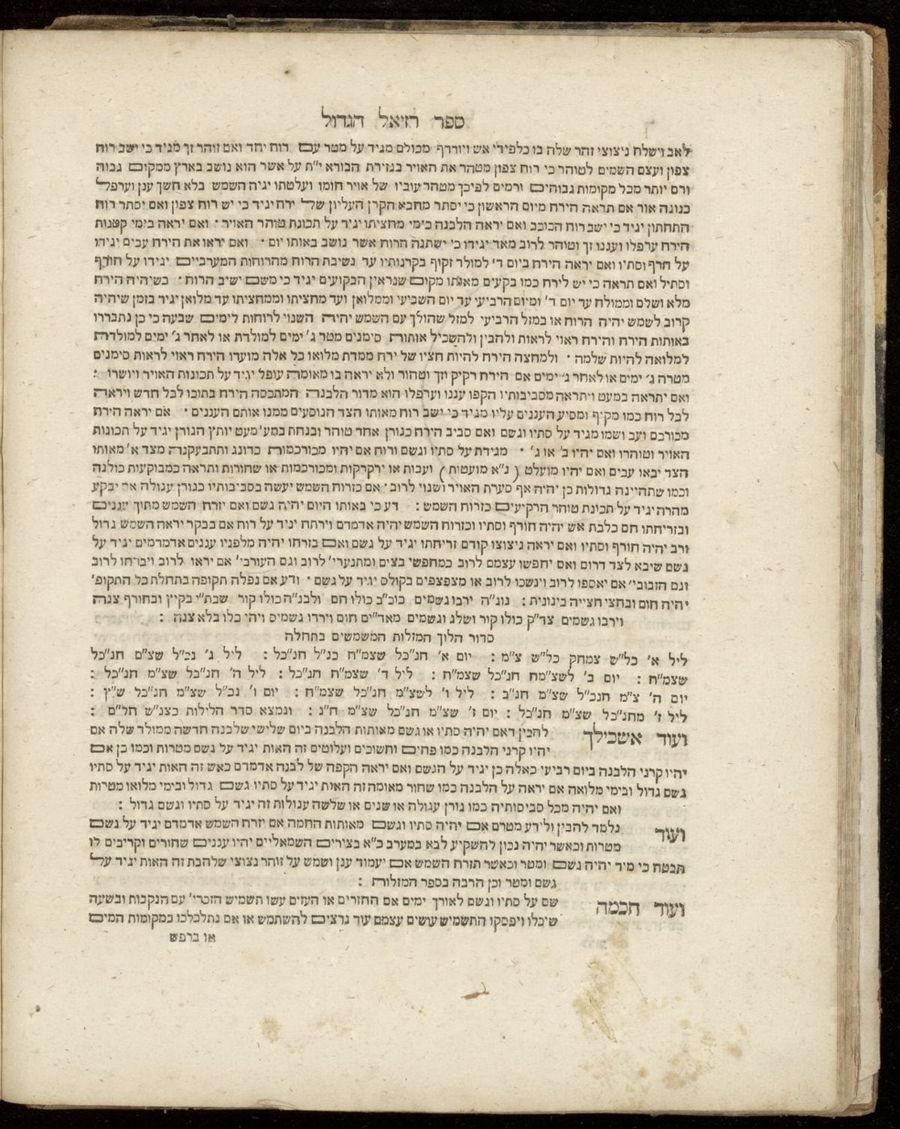
1701 printed page, scan page 52. Page image: Embassy of the Free Mind (Bibliotheca Philosophica Hermetica), Amsterdam, shelfmark Q, via Source Library. Public domain
Tap to open the scanPage image: Embassy of the Free Mind (Bibliotheca Philosophica Hermetica), Amsterdam, shelfmark Q, via Source Library. Public domain (CC PDM 1.0).
[p52] לא ואם ישלח ניצוצי זהר שלה בו כלפידי אש ויורדף מכולם מגיד על מטר עם רוח יחד ואם זוהר זך מגיד כי ישב רוח צפון ועצם השמים לטוהר כי רוח צפון מטהר את האויר בגזירת הבורא י"ת על אשר הוא נושב בארץ ממקום גבוה ורם יותר מכל מקומות גבוהים ורמים לפיכך מטהר עוביו של אויר חומו ועלטתו יגיה השמש בלא חשך ענן וערפל כנוגה אור אם תראה הירח מיום הראשון כי יסתר מחבא הקרן העליון של ירח יגיד כי יש רוח צפון ואם יסתר רוח התחתון יגיד כי ישב רוח הכוכב ואם יראה הלבנה בימי מחציתו יגיד על תכונת טוהר האויר · ואם יראה בימי קטנות הירח ערפלו ועננו זך וטוהר לרוב מאד יגידו כי ישתנה הרוח אשר נושב באותו יום · ואם יראו את הירח עבים יגידו על חורף וסתיו ואם יראה הירח ביום ד' למולד זקוף בקרנותיו עד נשיבת הרוח מהרוחות המערביים יגידו על חורף וסתיו ואם תראה כי יש לירח כמו בקעים מאותו מקום שנראין הבקועים יגיד כי משם ישיב הרוח · כשיהיה הירח מלא ושלם וממולת עד יום ד' ומיום הרביעי עד יום השביעי וממלואו ועד מחציתו וממחציתו עד מלואו יגיד בזמן שיהיה קרוב לשמש יהיה הרוח או במזל הרביעי למזל שהולך עם השמש יהיה השנוי לרוחות לימים שבעה כי כן נתבררו באותות הירח והירח ראוי לראות ולהבין ולהשכיל אותות סימנים מטר ג' ימים למולדת או לאחר ג' ימים למולדת למלואה להיות שלמה · ולמחצה הירח להיות חציו של ירח ממדת מלואו כל אלה מועדו הירח ראוי לראות סימנים מטרה ג' ימים או לאחר ג' ימים אם הירח רקיק וזך וטהור ולא יראה בו מאומה עופל יגיד על תכונות האויר ויושרו : ואם יתראה במעט ויתראה מסביבותיו הקפו עננו וערפלו הוא מרור הלבנה המתכסה הירח בתוכו לכל חרש ויראה לכל רוח כמו מקיף ומסיע העננים עליו מגיד כי ישב רוח מאותו הצד הנוסעים ממנו אותם העננים · אם יראה הירח מכורכם ועב ושמו מגיד על סתיו וגשם ואם סביב הירח כגורן אחר טוהר ובנחת במעט מעט יותץ הגורן יגיד על תכונות האויר וטוהרו ואם יהיו ב' או ג' · מגידת על סתיו וגשם ורוח אם יהיו מכורכמות כרונג ותתבעקנה מצד א' מאותו הצד יבאו עבים ואם יהיו מועלט (נ"א מועטות) ועבות או ירקרקות ומכורכמות או שחורות ותראה כמבוקעות כולנה וכמו שתהיינה גדולות כן יהיה אף סערת האויר ושנוי לרוב · אם כזרוח השמש יעשה בסביבותיו כגורן עגולה אם יבקע מהרה יגיד על תכונת טוהר הרקיעים כזרוח השמש : דע כי באותו היום יהיה גשם ואם יזרח השמש מתוך עננים ובזריחתו חם כלבת אש יהיה חורף וסתיו וכזרוח השמש יהיה אדמדם וירתח יגיד על רוח אם בבקר יראה השמש גדול ורב יהיה חורף וסתיו ואם יראה ניצוצו קודם זריחתו יגיד על גשם ואם בזרחו יהיה מלפניו עננים אדמדמים יגיד על גשם שיבא לצד דרום ואם יחפשו עצמם לרוב כמחפשי בצים ומתנערי' לרוב וגם העורבי' אם יראו לרוב ויברחו לרוב וגם הזבובי' אם יאספו לרוב וינשכו לרוב או מצפצפים בקולם יגיד על גשם · ודע אם נפלה תקופה בתחלת כל התקופ' יהיה חום ובחצי חציה בינונית : נוג"ה ירבו גשמים כוכ"ב כולו חם ולבנ"ה כולו קור שבת"י בקיץ ובחורף צנה וירבו גשמים צד"ק כולו קור ושלג וגשמים מאד"ים חום וירדו גשמים ויהי כלו בלא צנה : סדור הלוך המזלות המשמשים בתחלה ליל א' כל"ש צמחק כל"ש צ"מ : יום א' חנ"כל שצמ"ח כנ"ל חנ"כל : ליל ג' נב"ל שצ"ם חנ"כל שצמ"ח : יום ב' לשצ"מח חנ"כל שצמ"ח : ליל ד' שצמ"ח חנ"כל : ליל ה' חנ"בל שצ"מ חנ"כל : יום ה' צ"מ חנכ"ל שצ"מ חנ"ב : ליל ו' לשצ"מ חנ"כל שצמ"ח : יום ו' נכ"ל שצ"מ חנ"כל ש"ץ : ליל ז' מחנ"כל שצ"מ חנ"כל : יום ז' שצ"מ חנ"כל שצ"מ ח"נ : ונמצא סדר הלילות כצנ"ש חל"ם ועוד אשכילך להבין דאם יהיה סתיו או גשם מאותות הלבנה ביום שלישי שלבנה חדשה ממולד שלה אם יהיו קרני הלבנה כמו פחים וחשוכים ועלוטים זה האות יגיד על גשם מטרות וכמו כן אם יהיו קרני הלבנה ביום רביעי כאלה כן יגיד על הגשם ואם יראה הקפה של לבנה אדמדם כאש זה האות יגיד על סתיו גשם גדול ובימי מלואה אם יראה על הלבנה כמו שחור מאומה זה האות יגיד על סתיו גשם גדול ובימי מלואו מטרות ואם יהיה מכל סביבותיה כמו גורן עגולה או שנים או שלשה עגולות זה יגיד על סתיו וגשם גדול : ועוד נלמד להבין ולידע מטרם אם יהיה סתיו וגשם מאותות החמה אם יזרח השמש אדמדם יגיד על גשם מטרות וכאשר יהיה נכון להשקיע לבא במערב כ"א בצורים השמאליים יהיו עננים שחורים וקריבים לו תבטח כי מיד יהיה גשם ומטר וכאשר תזרח השמש אם יעמוד ענן ושמש על זוהר נצוצי שלהבת זה האות יגיד על גשם ומטר וכן הרבה בספר המזלות : ועוד חכמה שם על סתיו וגשם לאורך ימים אם החזרים או העזים עשו תשמיש הזכרי' עם הנקבות ובשעה שכלו ויפסקו התשמיש עשים עצמם עוד נרצים להשתמש או אם נתלכלכו במקומות המים [catchword] או ברפש

English AI-assisted draft translation · not a scholarly edition

p52. AI-assisted draft translation, not a scholarly edition. Literal; uncertain readings [unclear], misprints [sic]. Continues p49's catchword "much" (the end of the sentence "and if the sun burns much…"). …and if it sends out sparks of its brightness like torches of fire, and they chase after all of them [unclear: ויורדף מכולם], it tells of rain together with wind. If its brightness is clear, it tells that the north wind will blow and the very heavens will be pure. For the north wind purifies the air by decree of the Creator, may He be blessed, because it blows on the earth from a place higher and loftier than all high and lofty places. Therefore it purifies the thickness of the air, its heat and its murk, and the sun shines without the darkness of cloud and mist, like the brightness of light. If you see the moon from the first day [and] the upper horn of the moon is hidden as if in a hiding place, it tells that there is a north wind. If the lower [horn] is hidden, it tells that the wind [of] the star [unclear: הכוכב] will blow. If the moon is seen in the days of its half, it tells of conditions of pure air. If in the days of the moon's smallness its mist and cloud are seen as very clear and pure, they tell that the wind blowing that day will change. If they see the moon [behind] thick clouds, they tell of winter and autumn. If on the fourth day after the new moon (molad) the moon is seen upright in its horns until the blowing of a wind from the western winds, they tell of winter and autumn. If you see that the moon has something like cracks, it tells that the wind will blow from the place where the cracks are seen. When the moon is full and complete, and when it is circumcised [unclear: וממולת; perhaps "from its new moon"] to the fourth day, and from the fourth day to the seventh day, and from its fullness to its half, and from its half to its fullness, it tells: at the time that the wind is near the sun, or in the fourth sign from the sign that goes with the sun, the change of the winds will be for seven days. For so it has been made clear by the signs of the moon. The moon is fit to be seen, understood and considered for signs of rain three days from its birth or three days after its birth; at its fullness, when it is complete; and at the half moon, when half the moon is the measure of its fullness. At all these appointed times of the moon it is fit to look at signs of rain, three days [before] or three days after. If the moon is thin, clear and pure and nothing dark [unclear: עופל] is seen in it, it tells of [fair] conditions of the air and its evenness. If it is seen but little, and its ring, cloud and mist are seen around it — that is the bitterness [unclear: מרור] of the moon in which the moon is covered, every month — and it is seen on each side as if something surrounds it and moves the clouds over it, it tells that the wind will blow from the side from which those clouds travel. If the moon is seen yellowish and thick and dark [unclear: ושמו], it tells of autumn and rain. If around the moon there is something like a threshing-floor, after purity and gently, little by little, and the floor breaks up, it tells of [fair] conditions of the air and its purity. If there are two or three [rings], it tells of autumn, rain and wind. If they are yellowish like an orange [unclear: כרונג] and they break open on one side, the thick clouds will come from that side. If they are few [printed מועלט; another version מועטות, "few"] and thick, or greenish and yellowish, or black, and they all look as if split, then as large as they are, so great will be the storm of the air and the change. If at sunrise [the sun] makes a round threshing-floor around itself, if it breaks up quickly it tells of [fair] conditions of pure skies. At sunrise [unclear: a sentence seems to be missing]: know that on that day there will be rain. If the sun rises out of clouds and at its rising is hot like a flame of fire, there will be winter and autumn. If at sunrise it is reddish and seethes, it tells of wind. If in the morning the sun looks great and large, there will be winter and autumn. If its sparks are seen before it rises, it tells of rain. If at its rising there are reddish clouds before it, it tells of rain that will come on the south side. If [birds] search themselves much, like those who search for eggs [unclear: בצים — perhaps "for lice"], and shake themselves much, and also if the ravens are seen much and flee much, and also if the flies gather much and bite much, or chirp with their voices, it tells of rain. And know: if a season (tequfah) falls at the beginning of every season [unclear], there will be heat, and in half of its half [the weather] will be middling. [Under] Nogah, rains will increase; Kokhav, all of it hot; and Levanah, all of it cold; Shabbetai, in summer and in winter cold, and rains will increase; Tsedeq, all of it cold, snow and rains; Ma'adim, heat, and rains will fall, and it will all be without cold. [Heading] ORDER OF THE COURSE OF THE SIGNS [i.e. planets] WHICH SERVE FIRST [A table of planetary-hour sequences, written in initial letters of the seven planets: Sh = Shabbetai (Saturn), Ts = Tsedeq (Jupiter), M = Ma'adim (Mars), Ḥ = Ḥammah (Sun), N = Nogah (Venus), K = Kokhav (Mercury), L = Levanah (Moon). The print is irregular and several groups appear corrupt; they are given as printed.] Night 1: KLSh TsMḤQ [sic] KLSh TsM. Day 1: ḤNKL ShTsMḤ KNL ḤNKL. Night 3: NBL [sic] ShTsM ḤNKL ShTsMḤ. Day 2: LShTsMḤ ḤNKL ShTsMḤ. Night 4: ShTsMḤ ḤNKL. Night 5: ḤNBL [sic] ShTsM ḤNKL. Day 5: TsM ḤNKL ShTsM ḤNB [sic]. Night 6: LShTsM ḤNKL ShTsMḤ. Day 6: NKL ShTsM ḤNKL ShTs. Night 7: MḤNKL ShTsM ḤNKL. Day 7: ShTsM ḤNKL ShTsM ḤN. So the order of the nights is found to be K Ts N Sh Ḥ L M. [Display words] AND FURTHER I WILL TEACH YOU to understand whether there will be autumn or rain from the signs of the moon. On the third day of the new moon from its birth, if the horns of the moon are like [metal] plates [unclear: פחים], dark and murky, this sign tells of rain and downpour. Likewise if the horns of the moon are like this on the fourth day, it tells of rain. If the moon's ring looks reddish like fire, this sign tells of autumn and great rain. In the days of its fullness, if something like black is seen on the moon, this sign tells of autumn and great rain, and in the days of its fullness, downpours. If all around it there is something like a round threshing-floor, or two or three rings, this tells of autumn and great rain. [Display word] AND FURTHER we shall learn to understand and know, before it comes, whether there will be autumn and rain from the signs of the sun. If the sun rises reddish, it tells of rain and downpours. When it is about to set, going into the west, if black clouds come close to it on the left side [unclear: כ"א בצורים, "in the forms"], you may be sure that rain and downpour will come at once. When the sun rises, if a cloud stands [over it] and the sun [shines] over the brightness of sparks of flame, this sign tells of rain and downpour. There is much more of the same in the Book of the Signs (Sefer ha-Mazzalot). [Display words] AND FURTHER, WISDOM about autumn and rain for many days: if the boars [printed החזרים; read חזירים] or the goats have mated, males with females, and at the time they have finished and stopped mating they still make themselves eager to mate, or if they have rolled in watery places [Catchword] or in mire (או ברפש)

Hebrew as printed, read from the scan

1701 printed page, scan page 51. Page image: Embassy of the Free Mind (Bibliotheca Philosophica Hermetica), Amsterdam, shelfmark Q, via Source Library. Public domain
Tap to open the scanPage image: Embassy of the Free Mind (Bibliotheca Philosophica Hermetica), Amsterdam, shelfmark Q, via Source Library. Public domain (CC PDM 1.0).
[p51] או ברפש וטיט ורוצים להתלכלך יותר וגם כשרוצי' לרעות וחופשי' מרעיתם מתחת לארץ עד קצות שפתי פיותיהן · וגם ממתיחים ראשם כנגד צד צפון וגם הכלבי' אם יחפרו בארץ וכן הזאב אם פניו קרוב לעזים או קרוב לבתי הוילון וגם אם יטבלו שוורים שפתותיהם במראה המים ובמעיינות ולא מפני צמא מפני תאוות שתייה וגם האווזים אם ילכו קוראים בכח מאכל מזרעתו וגם קורי עכביש אם יפלו מעצמן בלא הפחת רוח כל זה יגיד על סתיו וגשם לאורך ימים ובעת שהלבנה חסרה נקראת מאור קטון ואז אין ממשלת הכוכבי' ברקיע כי אם צ"ח כוכבי' מניין כוכבי' וכשקטרג' לבנה על לבונתיה ונעשה הכוכבים בארם שמכה על עץ השרף ויוצאין שביבי' לכך הכוכבים עם הלבנה יוצאי' ומתחלת העולם צרף האותיות וגלגול הדבורים וחשבונם ומניינם ומספר' וחושב חשבון כוכבי' ומזלות וחשבון תקופות ומחזורות של ככבי' ושל תלי ושל מזלות שהיה עתיד וסדר ולבראות והיה עורך החשבון כולו לפניו כדי לראות הדורות העתידין להבראות מראש ועד סוף ככתוב מי פעל ועשה קורא הדורות מראש קודם בריאות עולם כדי להבין מעשה כל אדם וצדקתו ורשעתו ולגזור על כל אחד ואחד לפי מעשיו העתיד לעשות בין טוב ובין רע ומנה כוכבי' ומזלות עליהם ומנה כוכבו ומזלו שיזרע בשעת זריעתו ובשעת מולדו בין טוב ובין רע וכל אלה עשאם האלהים בחכמתו ובתבונתו קודם שיזרח העולם שנ' ה' בחכמה יסד ארץ אעפ"י שמנה כוכבי' ומזלו של כל אדם טרם שיברא העולם לפי מעשיו שעתיד אדם לעשות ולא נתן הקב"ה לכוכבים ולמזלות רשיון להרע או להטיב תחלה עד שראה שהאדם לבראות שלא היה נכון בלא יצר דכתיב כי יצר לב האדם רע מנעוריו ועל זה האלהי' רחום וחנון הוא ונחם על הרעה ערך ותקן התשובה מתחלת הבריאה דכתיב בטרם הרים ילדו וגומר' · תשב אנוש עד דכא שאם יחטא וישוב שינחם ה' אלהים זהו אין מזל קבוע כי הכל לפי מה שהאדם באותה שעה דנן כדכתי' בישמעאל באשר הוא שם ובמזלות המאורים שבה יראו כל הזמנים לכך אומרי' בלילה ומחליף את הזמנים ומשתנה העתים ולא בשחרית : והתרנגול כשמשכים לקרוא בלילה ישתנה הזמן ולמחר יהיו עננים כי הענן נכנס בחרטומו ופעמים לבנה בלילה פעמים אינה מאירה זהו ומחליף את הזמנים ומשנה עתים ובשלשה כוכבים לילה : זהו המבדיל בין יום ובין לילה אבל בבקר אף על פי שראו עשרה חשוב יום זהו דכתיב עושה שחר ועיפה וגומר ה' צבאות שמו : למד כנגר ה' המאורות מה ל' גבוהה על כל האותיות כן הקב"ה על כל בריותיו וצופה הכל מתחלת בריאת עולם במאמ' יהי אור זהו נהר דינור שממנו הולכי' כל המאורו' כדאמרינן בהרואה אלמלא זנב כימה בנהר דינור אין בריה יכולה לעמוד בקור ולכך חמה ולבנה וכוכבי' נראין אדומ' ומה שאחה הולכות חמה ביום היתה הולכות נהר דינור ובמקום הליכות חמה ביום נהר דינור הולך ואותו הלוך קורא יום שנקרא עת היום ובמקו' הליכות חמה בלילה היה הכל מים והיה לו כמו רפוסת שהולך בהם ולאותו מקום נקרא לילה זהו ויבדל אלהים בין האור נהר דינור ובין החשך חשכת מים עבי שחקי' זהו ויקרא אלהי' לאור יום כלומר נהר דינור שבהן בטלות המאורות ממהלך שאם לא תאמר כן מאי ויהי ערב ויהי בקר והרי נחלו המאורות אלא נהר דינור מהלך כמו עתה החמה כלומר לאור יום נהר דינור ולחשך קרא לילה לחשכת מים שהם דרך החמה ובהשכמה יהיה אור נהר דינור עד חצי יום שנהר דינור עולה למזרח ולמערב ביום רביעי הוציא מנהר דינור כמו בחצי היום שנהר דינור עולה ולבנה וכוכבי' עולים נאמר במדות השמי' לפי לכת בערכן מרדו חכמי' ש"ס מדרגות וי"ב מזלות צמודין בו ושמותם טל"ה שו"ר תאומ"ים סרט"ן אר"יה בתול"ה מאזני"ם עקר"ב קש"ת גד"י דל"י דג"ים וכל מלך נ"א מהלך מהם ל' מדרגות וכל מדריג' ומדריג' ס' גסטראות וכל גסטרא ס' ברקוגות וכל ברקון ס' אולות וכל אולות ס' אורות וכל אורות ס' סיטות וכל סוטות ס' רופוסאות וכל אפורסאות ס' חרופות כהרף עין נטל זה חשבון בידיך עד י"א וי"ב דברי' אחרי' מין דקרוקי חשבון אבל הככבו' היורדי' והעולם ומנהיגי' את העול' ושמותן שב"תי צד"ק מאדי"ם חמ"ה נוג"ה כוכ"ב לבנ"ה וכל אחד ואחד יש לו חלק בכל האחד מן אלו הכוכבי' בתלי דראק"ון דינור היה מקיף אז כמו עתה המזלות והתלי שמגלגלי' והלכי' בשמי' כי בתלי י"ב נוזה י"ב נותני' ז' מעדנות כימה וה' מושכות המזלות והתלי שמגלגלי' והולכין בשמי' ובארץ ז' וה' הם י"ב סביב הגלגל מקושרי' מבית והם פתוחי' מבחוץ וזריחות שבעה מימין לצפון וה' מצפון לימין וכנגדם נאספים ששה ביום וששה בלילה תאומים בסוף השבעה ועקרב בסוף ה' מן התאומי' לקשת ומעקרב לסרטן כמו כן ונאספין עגלה לעקרב עגלה בצפון עקרב בדרום זורח ענול כלפי דרום שוקע נוטרה כלפי צפון ובצפון עגלה זורחת ומחזרת את התלי והתלי למזלות והמזלות לגלגל והגלגל חוזר בגלגל דרי ומזלות כסרנים ותלי כמלך כמנהיג ראש בראש הששה וזנב התלי בסוף הששה הראש מהלך ישר והזנב כמהלך הפך כן הירח מתחלת · העולם נהר דינור סובב ולאחור מכאן פ' ים ביום ד' היקפא מנהר דינור ראש וברא חמה להאיר ביום על הארץ ונהר דינור אצל המזלות לחסם קור כימה ושלג לבנה וכיוצא בהן : [catchword] על כן

English AI-assisted draft translation · not a scholarly edition

p51. AI-assisted draft translation, not a scholarly edition. Literal; uncertain readings [unclear], misprints [sic]. Continues p52's catchword "or in mire". Faint show-through of a large circular diagram from the other side of the leaf is visible across the lower text; it is not part of this page. …or in mire and mud, and they want to dirty themselves even more; and also when they want to graze and they dig [printed וחופשי'] their pasture under the ground up to the edges of their lips; and also [if] they stretch their heads toward the north side; and also the dogs, if they dig in the ground; and likewise the wolf, if its face is close to the goats or close to the curtained houses [unclear: הוילון]; and also if oxen dip their lips into the look of the water and into springs, not from thirst but from a desire to drink; and also the geese, if they go about crying loudly [for] food from their seed [unclear]; and also spiders' webs, if they fall of themselves without a breath of wind — all this tells of autumn and rain for many days. When the moon is waning it is called "the small light" (Gen. 1:16), and then there is no dominion of the stars in the firmament except for 98 [צ"ח] stars, a number of stars [unclear]. When the moon accused [unclear: וכשקטרג'] concerning its brightness, the stars were made like a man [printed בארם] who strikes on the wood of the resin-tree [עץ השרף] and sparks fly out. Therefore the stars go out with the moon. From the beginning of the world [God] combined the letters and the rolling of the words, their reckoning, their count and their number. He reckoned the reckoning of stars and signs, and the reckoning of seasons and cycles of the stars, of the Teli and of the signs, which were destined and ordered to be created. He laid the whole reckoning out before Him in order to see the generations destined to be created, from beginning to end, as it is written "Who has wrought and done it? He who calls the generations from the beginning" (Isa. 41:4) — before the creation of the world. [He did this] in order to understand the deeds of every man, his righteousness and his wickedness, and to decree upon each one according to the deeds he is destined to do, whether good or evil. He appointed stars and signs over them, and He appointed his star and his sign which would be sown at the hour of his conception and at the hour of his birth, whether good or evil. All these God made in His wisdom and His understanding before the world shone, as it is said "The LORD by wisdom founded the earth" (Prov. 3:19). Although He appointed the stars and sign of every man before the world was created, according to the deeds that man is destined to do, the Holy One, blessed be He, did not at first give the stars and the signs permission to do evil or good. [This was] until He saw that man was to be created and that he could not exist without the inclination, as it is written "for the inclination of man's heart is evil from his youth" (Gen. 8:21). And for this reason God, compassionate and gracious, who relents of evil (Joel 2:13), arranged and established repentance from the beginning of creation, as it is written "Before the mountains were brought forth…" (Ps. 90:2), "You turn man to contrition" (Ps. 90:3): that if he sins and repents, the LORD God will relent. This is [the meaning of] "there is no fixed sign" [cf. b. Shabbat 156a, "Israel has no sign"], for everything is according to what the man is at that hour he is judged, as it is written of Ishmael "where he is" (Gen. 21:17). And by the signs of the lights in it all the times are seen. Therefore they say [in the blessing] "at night" [i.e. in the evening prayer], "and changes the times and alters the seasons", and not in the morning prayer. When the cock rises early to crow at night, the weather will change and tomorrow there will be clouds, for the cloud enters its beak [unclear]. Sometimes the moon [shines] at night and sometimes it does not give light: this is "and changes the times and alters the seasons". And [when] three stars [are seen] it is night; this is "who divides between day and night". But in the morning, even if they saw ten [stars], it counts as day. This is what is written "who makes the dawn into darkness… the LORD of hosts is His name" (Amos 4:13). Learn, corresponding to the five lights, why the Lamed is high above all the letters: so is the Holy One, blessed be He, above all His creatures, and He foresees everything from the beginning of the world's creation. By the utterance "Let there be light" (Gen. 1:3) — this is the River of Fire (Nehar Dinur), from which all the lights go, as we say in [the chapter] Ha-Ro'eh: "Were it not for the tail of Kimah [the Pleiades] in the River of Fire, no creature could withstand the cold" (b. Berakhot 58b). Therefore the sun, the moon and the stars look red. Where the sun now goes by day, the River of Fire used to go; in the place of the sun's course by day the River of Fire goes, and that course is called "day", which is called the time of day. In the place of the sun's course by night everything was water, and it had something like rafts [unclear: רפוסת] which travelled on them, and that place is called "night". This is "And God divided between the light" — the River of Fire — "and the darkness" — the darkness of waters, thick clouds of the skies (Ps. 18:12). This is "And God called the light Day" (Gen. 1:5), that is, the River of Fire, in which the lights rest [unclear: בטלות] from their course. For if you do not say so, what is "and there was evening and there was morning" (Gen. 1:5), when the lights had not yet [been made]? Rather, the River of Fire went as the sun does now. That is, the light of day [is] the River of Fire, "and the darkness He called Night" — the darkness of waters, which are the way of the sun. At dawn there will be the light of the River of Fire until midday, for the River of Fire rises in the east and in the west. On the fourth day He brought out from the River of Fire [the lights], as at midday when the River of Fire rises, and the moon and the stars rise. It is said, in the measures of the heavens according to their going in their order, that the sages measured 360 [ש"ס] degrees, with 12 signs joined to it. Their names are Ṭaleh (Aries), Shor (Taurus), Te'omim (Gemini), Sarṭan (Cancer), Aryeh (Leo), Betulah (Virgo), Moznayim (Libra), ʿAqrav (Scorpio), Qeshet (Sagittarius), Gedi (Capricorn), Deli (Aquarius), Dagim (Pisces). Each king [another version: course] of them is 30 degrees. Each degree is 60 gesṭra'ot [unclear units], each gesṭra 60 barqonot, each barqon 60 ulot, each ulah 60 orot, each orah 60 siṭot, each soṭah 60 rofusa'ot, and each afursa 60 ḥarufot — as the blink of an eye. Take this reckoning in your hand up to the eleventh and twelfth [order]; [there are] other matters, a kind of fine points of reckoning. But the stars which descend and ascend and guide the world have the names Shabbetai, Tsedeq, Ma'adim, Ḥammah, Nogah, Kokhav, Levanah, and each one has a share in each one of these stars, in the Teli, the Dragon (Draqon) [unclear: דראק"ון]. The River of Fire then encircled, as now the signs and the Teli roll and go in the heavens. For in the Teli are 12 [unclear: נוזה], 12 giving seven delights, Kimah, and five drawing [cf. Job 38:31, "the delights of Kimah… the cords of Kesil"], the signs and the Teli which roll and go in the heavens; and on earth, seven and five, which are 12, around the sphere, tied on the inside and open on the outside. Seven rise from right to north and five from north to right. Opposite them, six are gathered by day and six by night: Gemini at the end of the seven, and Scorpio at the end of the five, from Gemini to Sagittarius and from Scorpio to Cancer likewise. The Wagon is gathered against Scorpio: the Wagon in the north, Scorpio in the south. [Scorpio] rises in a circle [printed ענול] toward the south and sets, guarded [unclear: נוטרה], toward the north. In the north the Wagon rises and turns the Teli; the Teli [turns] the signs, the signs the sphere, and the sphere turns in the sphere of the generations [unclear: דרי]. The signs are like lords (seranim) and the Teli is like a king, like a leader: the head at the head of the six and the Teli's tail at the end of the six. The head goes straight and the tail goes as if reversed; so did the moon. From the beginning of the world the River of Fire went round, and behind it from here [unclear: פ' ים]. On the fourth day He surrounded [unclear: היקפא] the head with the River of Fire, and He created the sun to give light by day upon the earth, and the River of Fire beside the signs, to hold back the cold of Kimah, snow, the moon, and the like. [Catchword] Therefore (על כן)
Scripture on this page · 13 references with the KJV text

References are given as printed, in Hebrew chapter and verse numbering. Where the KJV numbers the verse differently (mostly Psalms, which count the title as verse 1 in Hebrew), the KJV reference is shown. KJV text: King James Version (1769 text), public domain; text from github.com/thiagobodruk/bible (en_kjv.json), fetched 28 Oct 2026. Genesis, Exodus and Leviticus also show the Gutenberg Bible on this site (/gb/): Latin Vulgate in Gutenberg spelling with the Douay-Rheims English.

  • Genesis 1:16
    KJV: And God made two great lights; the greater light to rule the day, and the lesser light to rule the night: he made the stars also.
    Gutenberg Bible, leaf 005r: Fecitque Deus duo luminaria magna: luminare maius, ut preesset diei: et luminare minus, ut preesset nocti: et stellas. — And God made two great lights: a greater light to rule the day; and a lesser light to rule the night: and the stars.
  • Isaiah 41:4
    KJV: Who hath wrought and done it , calling the generations from the beginning? I the LORD , the first, and with the last; I am he.
  • Proverbs 3:19
    KJV: The LORD by wisdom hath founded the earth; by understanding hath he established the heavens.
  • Genesis 8:21
    KJV: And the LORD smelled a sweet savour; and the LORD said in his heart, I will not again curse the ground any more for man’s sake; for the imagination of man’s heart is evil from his youth; neither will I again smite any more every thing living, as I have done.
    Gutenberg Bible, leaf 008r: Odoratusque est Dominus odorem suavitatis, et ait: Nequaquam ultra maledicam terre propter homines: sensus enim et cogitatio humani cordis in malum prona sunt ab adolescentia sua: non igitur ultra percutiam omnem animam viventem sicut feci. — And the Lord smelled a sweet savour, and said: I will no more curse the earth for the sake of man: for the imagination and thought of man's heart are prone to evil from his youth: therefore I will no more destroy every living soul as I have done.
  • Joel 2:13
    KJV: And rend your heart, and not your garments, and turn unto the LORD your God: for he is gracious and merciful, slow to anger, and of great kindness, and repenteth him of the evil.
  • Psalms 90:2
    KJV: Before the mountains were brought forth, or ever thou hadst formed the earth and the world, even from everlasting to everlasting, thou art God.
  • Psalms 90:3
    KJV: Thou turnest man to destruction; and sayest, Return, ye children of men.
  • Genesis 21:17
    KJV: And God heard the voice of the lad; and the angel of God called to Hagar out of heaven, and said unto her, What aileth thee, Hagar? fear not; for God hath heard the voice of the lad where he is .
    Gutenberg Bible, leaf 013r: Exaudivit autem Deus vocem pueri: vocavitque angelus Dei Agar de celo, dicens: Quid agis Agar? noli timere: exaudivit enim Deus vocem pueri de loco in quo est. — And God heard the voice of the boy: and an angel of God called to Agar from heaven, saying: What art thou doing, Agar? fear not; for God hath heard the voice of the boy, from the place wherein he is.
  • Amos 4:13
    KJV: For, lo, he that formeth the mountains, and createth the wind, and declareth unto man what is his thought, that maketh the morning darkness, and treadeth upon the high places of the earth, The LORD , The God of hosts, is his name.
  • Genesis 1:3
    KJV: And God said, Let there be light: and there was light.
    Gutenberg Bible, leaf 005r: Dixitque Deus: Fiat lux. Et facta est lux. — And God said: Be light made. And light was made.
  • Psalms 18:12 Hebrew numbering; KJV Psalms 18:11
    KJV: He made darkness his secret place; his pavilion round about him were dark waters and thick clouds of the skies.
  • Genesis 1:5
    KJV: And God called the light Day, and the darkness he called Night. And the evening and the morning were the first day.
    Gutenberg Bible, leaf 005r: Appellavitque lucem Diem, et tenebras Noctem: factumque est vespere et mane, dies unus. — And he called the light Day, and the darkness Night; and there was evening and morning one day.
  • Job 38:31
    KJV: Canst thou bind the sweet influences of Pleiades, or loose the bands of Orion?

Hebrew as printed, read from the scan
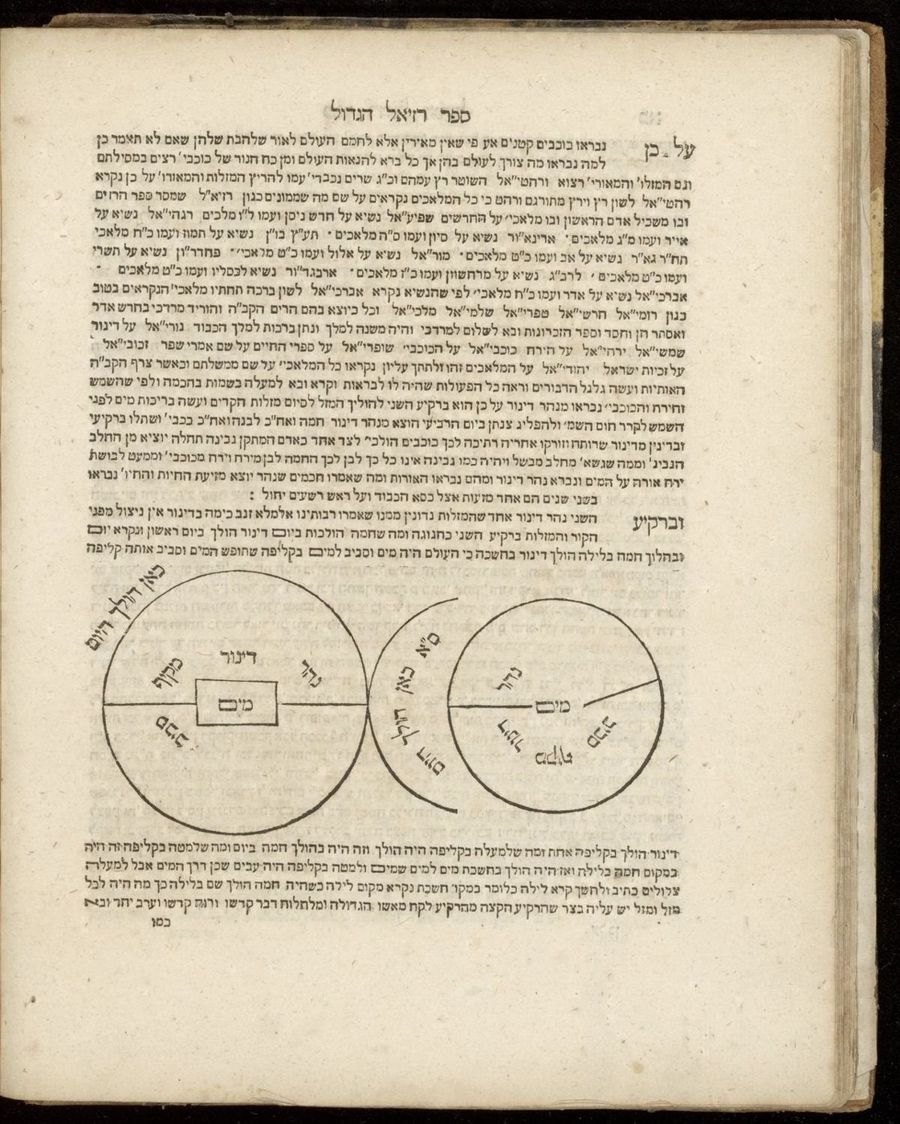
1701 printed page, scan page 54. Page image: Embassy of the Free Mind (Bibliotheca Philosophica Hermetica), Amsterdam, shelfmark Q, via Source Library. Public domain
Tap to open the scanPage image: Embassy of the Free Mind (Bibliotheca Philosophica Hermetica), Amsterdam, shelfmark Q, via Source Library. Public domain (CC PDM 1.0).
[p54] על כן נבראו כוכבים קטנים אע"פ שאין מאירין אלא לחמם העולם לאור שלהבת שלהן שאם לא תאמר כן למה נבראו מה צורך לעולם בהן אך כל ברא להנאות העולם ומן כח תנור של כוכבי' רצים במסילתם וגם המזלו' והמאורי' רצוא ורהטי"אל השוטר רץ עמהם וכ"ג שרים נכברי' עמו להריץ המזלות והמאורו' על כן נקרא רהטי"אל לשון רץ וירץ מתורגם ורהט כי כל המלאכים נקראים על שם מה שממונים כגון רזיא"ל שמסר ספר הרזים ובו משכיל אדם הראשון ובו מלאכי' על החרשים שפיע"אל נשיא על חרש ניסן ועמו ל"ו מלכים רגהי"אל נשיא על אייר ועמו מ"ג מלאכים · ארינא"ור נשיא על סיון ועמו ס"ה מלאכים · תע"ץ בו"ן נשיא על תמוז ועמו כ"ח מלאכי' תח"ר גא"ר נשיא על אב ועמו כ"ט מלאכים · מור"אל נשיא על אלול ועמו כ"ט מלאכי' · פחדר"ון נשיא על תשרי ועמו כ"ט מלאכים · לרב"ג נשיא על מרחשון ועמו כ"ז מלאכים · ארבג"ד"ור נשיא לכסליו ועמו כ"ט מלאכים · אברכי"אל נשיא על אדר ועמו כ"ח מלאכי' לפי שהנשיא נקרא אברכי"אל לשון ברכה תחתיו מלאכי' הנקראים בטוב כגון רומי"אל הרשי"אל טפרי"אל שלמי"אל מלכי"אל וכל כיוצא בהם הרים הקב"ה והוריד מרדכי בחרש אדר ואסתר הן וחסד וספר הזכרונות ובא לשלום למרדכי והיה משנה למלך ונתן ברכות למלך הכבוד נורי"אל על דינור שמשי"אל ירחי"אל על הירח כוכבי"אל על הכוכבי' שופרי"אל על ספרי החיים על שם אמרי שפר זכובי"אל על זכיות ישראל יהודי"אל על המלאכים זהו זלתתך עליון נקראו כל המלאכי' על שם ממשלתם וכאשר צרף הקב"ה האותיות ועשה גלגל הדבורים וראה כל הפעולות שהיה לו לבראות וקרא ובא למעלה בשמות בחכמה ולפי שהשמש זהירת והכוכבי' נבראו מנהר דינור על כן הוא ברקיע השני להוליך המזל לסיום מזלות הקדים ועשה בריכות מים לפני השמש לקרר חום השמי' ולהפליג צנתן ביום הרביעי הוצא מנהר דינור חמה ואח"כ לבנה ואח"כ כבבי' ושתלו ברקיע זבריגין מדינור שרותתו וזורקו אחריה רתיכה לכך כוכבים הולכי' לצד אחד כאדם המתקן גבינה תחלה יוציא מן החלב הגבינ' וממה שנשא' מחלב מבשל ויהיה כמו גבינה אינו כל כך לבן לכך החמה לבן מירח וירח מכוכבי' וממעט לבושת ירח אורה על המים ונברא נהר דינור ומהם נבראו האורות ומה שאמרו חכמים שנהר יוצא מזיעת החיות והחיו' נבראו בשני שנים הם אחד מזעות אצל כסא הכבוד ועל ראש רשעים יחול : וברקיע השני נהר דינור אחד שהמזלות נדונין ממנו שאמרו רבותינו אלמלא זנב כימה בדינור אין ניצול מפני הקור והמזלות ברקיע השני כחגוגה ומה שחמה הולכות ביום דינור הולך ביום ראשון ונקרא יום ובהלוך חמה בלילה הולך דינור בחשכה כי העולם היה מים וסביב למים בקליפה שתופש המים וסביב אותה קליפה [diagram — see scan: three overlapping circles. The large left circle is labelled כאן הולך היום, with נהר דינור (top and sides), מקיף, and a central box מים, plus a lower label (partly cut: ...ככב/כגב [unclear]). The middle circle is labelled ...ס"א / כאן הולך [unclear]. The right circle is labelled נהר / מים / ...טלם [unclear] ...] דינור הולך בקליפה אחת ומה שלמעלה בקליפה היה הולך וזה היה כהולך חמה ביום ומה שלמטה בקליפה זה היה במקום חמה בלילה ואז היה הולך בחשכת מים לחשכת מים למים שמים ולמטה בקליפה היה עבים שכן דרך המים אבל למעלה צלולים כתיב ולחשך קרא לילה כלומר במקו' חשכת נקרא מקום לילה כשהיה חמה הולך שם בלילה כן מה היה לכל מזל ומזל יש עליה בצד שהרקיע הקצה מהרקיע לקח מאשו הגדולה ומלתלות דבר קדשו ורוח קדשו וערב יחד ובא [catchword] כמו

English AI-assisted draft translation · not a scholarly edition

p54. AI-assisted draft translation, not a scholarly edition. Literal; uncertain readings [unclear], misprints [sic]. Continues p51's catchword "Therefore". The large diagram of three circles in the lower half is given as "see scan". [Display words] THEREFORE small stars were created. Although they do not give light, [they exist] only to warm the world with the light of their flame. For if you do not say so, why were they created, and what need does the world have of them? But everything He created for the benefit of the world. And from the power of the furnace of the stars they run in their courses, and also the signs and the lights run to and fro (Ezek. 1:14). Rahaṭi'el (רהטיאל), the officer, runs with them, and 23 honoured princes with him, to make the signs and the lights run. Therefore he is called Rahaṭi'el, from the word "run" — "and he ran" is rendered in [Aram.] targum as "and he ran" (ורהט). For all the angels are called by the name of what they are appointed over: for example Razi'el (רזיאל), who handed over the Book of Secrets (Sefer ha-Razim), from which Adam the first man gained understanding. In it are [also] the angels over the months: Shefi'el (שפיעאל), prince over the month of Nisan, and with him 36 kings. Ragahi'el (רגהיאל), prince over Iyyar, and with him 43 angels. Arina'or (ארינאור), prince over Sivan, and with him 65 angels. Taʿats Bon (תעץ בון), prince over Tammuz, and with him 28 angels. Taḥar Gaʾar (תחר גאר), prince over Av, and with him 29 angels. Mori'el [printed מור"אל] (מוראל), prince over Elul, and with him 29 angels. Paḥdaron (פחדרון), prince over Tishri, and with him 29 angels. Larbag (לרבג), prince over Marḥeshvan, and with him 27 angels. Arbagdor (ארבגדור), prince over Kislev, and with him 29 angels. [Tevet and Shevat are not given, sic.] Avarkhi'el (אברכיאל), prince over Adar, and with him 28 angels — because the prince is called Avarkhi'el, from the word "blessing" (berakhah). Under him are angels called by good [names], such as Rumi'el (רומיאל), Harshi'el (הרשיאל), Ṭafri'el (טפריאל), Shelmi'el (שלמיאל), Malki'el (מלכיאל) and all such. [In Adar] the Holy One, blessed be He, raised up Mordecai and brought [Haman] down, in the month of Adar; and Esther [found] favour and grace (Esth. 2:17); and the Book of Records (Esth. 6:1); and peace came to Mordecai (Esth. 10:3), and he was second to the king (Esth. 10:3), and he gave blessings to the King of Glory. Nuri'el (נוריאל) is over the [River of] Fire (Dinur); Shimshi'el (שמשיאל) [over the sun]; Yarḥi'el (ירחיאל) over the moon; Kokhavi'el (כוכביאל) over the stars; Shofri'el (שופריאל) over the books of life, from "goodly words" (Gen. 49:21, imrei shefer); Zekhuvi'el (זכוביאל) over the merits (zekhuyot) of Israel; Yehudi'el (יהודיאל) over the angels. This is "to give you high" [unclear: זלתתך עליון; cf. Deut. 28:1, "to set you high"]. All the angels are called by the name of their dominion. When the Holy One, blessed be He, combined the letters and made the wheel of the words, and saw all the works He was to create, He called and came on high [unclear] with names in wisdom. Because the sun is bright [unclear: זהירת] and the stars were created from the River of Fire, it [the sun] is therefore in the second firmament, to lead the sign to the end of the eastern [unclear: הקדים] signs. He made pools of water before the sun to cool the heat of the heavens and to carry their coolness far. On the fourth day He brought out from the River of Fire the sun, after that the moon, and after that the stars, and He planted them in the firmament: sparks [unclear: זבריגין; Aram.?] from the [River of] Fire, which He seethes and throws after it, a chariot [unclear]. Therefore the stars go to one side. It is like a man who prepares cheese: first he brings the cheese out of the milk, and from what is left of the milk he cooks, and it becomes like cheese but is not as white. Therefore the sun is whiter than the moon and the moon than the stars, and He lessened the moon's garment of light upon the waters. The River of Fire was created, and from them the lights were created. As for what the sages said, that the river comes out of the sweat of the Ḥayyot (b. Ḥagigah 13b), the Ḥayyot were created on the second [day]. Two [things] are one: the sweat beside the Throne of Glory, and "it shall fall upon the head of the wicked" (Jer. 23:19). [Display word] AND IN THE SECOND FIRMAMENT is one River of Fire, by which the signs are judged [unclear: נדונין; perhaps "warmed"]. For our Rabbis said: "Were it not for the tail of Kimah in the [River of] Fire, none would be saved from the cold" (cf. b. Berakhot 58b). The signs are in the second firmament like a circle [unclear: כחגוגה]. Where the sun goes by day, the [River of] Fire went on the first day, and it was called "day". Where the sun goes by night, the [River of] Fire went in darkness. For the world was water, and around the water [was] a shell (qelippah) which holds the water, and around that shell [Diagram — see scan: three overlapping circles. The left circle is labelled "here the day goes" (כאן הולך היום), "River of Fire" (נהר דינור), "surrounding" (מקיף), and a central box "water" (מים). The middle and right circles carry further labels, partly legible: "here goes…", "water", "river".] …the [River of] Fire went, in one shell. What was above in the shell it went in, and this was like the sun's course by day. What was below in the shell was in the place of the sun at night. Then it went in the darkness of waters — darkness of waters to waters, the heavens [unclear]. Below in the shell there were thick clouds, for such is the way of waters, but above it is written "clear" [unclear]. "And the darkness He called Night" (Gen. 1:5): that is, the place of darkness is called the place of night, when the sun went there at night. So what was for each and every sign: it has above it, at the side where the firmament [ends], the end of the firmament. He took from His great fire and from the hanging [unclear: ומלתלות] of the word of His holiness and His holy spirit, and mixed them together, and it came [Catchword] like (כמו)
Scripture on this page · 8 references with the KJV text

References are given as printed, in Hebrew chapter and verse numbering. Where the KJV numbers the verse differently (mostly Psalms, which count the title as verse 1 in Hebrew), the KJV reference is shown. KJV text: King James Version (1769 text), public domain; text from github.com/thiagobodruk/bible (en_kjv.json), fetched 28 Oct 2026. Genesis, Exodus and Leviticus also show the Gutenberg Bible on this site (/gb/): Latin Vulgate in Gutenberg spelling with the Douay-Rheims English.

  • Ezekiel 1:14
    KJV: And the living creatures ran and returned as the appearance of a flash of lightning.
  • Esther 2:17
    KJV: And the king loved Esther above all the women, and she obtained grace and favour in his sight more than all the virgins; so that he set the royal crown upon her head, and made her queen instead of Vashti.
  • Esther 6:1
    KJV: On that night could not the king sleep, and he commanded to bring the book of records of the chronicles; and they were read before the king.
  • Esther 10:3
    KJV: For Mordecai the Jew was next unto king Ahasuerus, and great among the Jews, and accepted of the multitude of his brethren, seeking the wealth of his people, and speaking peace to all his seed.
  • Genesis 49:21
    KJV: Naphtali is a hind let loose: he giveth goodly words.
    Gutenberg Bible, leaf 028v: Nephthali, cervus emissus, et dans eloquia pulchritudinis. — Nephthali, a hart let loose, and giving words of beauty.
  • Deuteronomy 28:1
    KJV: And it shall come to pass, if thou shalt hearken diligently unto the voice of the LORD thy God, to observe and to do all his commandments which I command thee this day, that the LORD thy God will set thee on high above all nations of the earth:
  • Jeremiah 23:19
    KJV: Behold, a whirlwind of the LORD is gone forth in fury, even a grievous whirlwind: it shall fall grievously upon the head of the wicked.
  • Genesis 1:5
    KJV: And God called the light Day, and the darkness he called Night. And the evening and the morning were the first day.
    Gutenberg Bible, leaf 005r: Appellavitque lucem Diem, et tenebras Noctem: factumque est vespere et mane, dies unus. — And he called the light Day, and the darkness Night; and there was evening and morning one day.

Hebrew as printed, read from the scan
1701 printed page, scan page 53. Page image: Embassy of the Free Mind (Bibliotheca Philosophica Hermetica), Amsterdam, shelfmark Q, via Source Library. Public domain
Tap to open the scanPage image: Embassy of the Free Mind (Bibliotheca Philosophica Hermetica), Amsterdam, shelfmark Q, via Source Library. Public domain (CC PDM 1.0).
[p53] כמו זכוכית והיה לח ורקעו וטפחו דכתיב ימינו טפחה שמים וכשנתייבש הרקיע זהו הרקיע עשו' לשחקים כלומר הרקיע כשהיה לח חזקים כראי מוצק זהו כשנתייבש נוטה שמים לבדו ודורך על במתי ים זהו כשנתייב' לאחר ומתחם כאהל לשבת שמתח השפע והכל על ידי הרוח כדכתיב ברוחו שמים שפרה ומן הרקיע עצמו למעלה היה מוצא כחו קורות שהן בולטין וכן השמי' מלא מים ובין קורה לקורה נקרא עליה ויש מהם המים מונחי' בה ויש לכל מזל ומזל עליה למעלה זהו המקרה במים עליותיו ועל כרחך אתה צריך לומר שהקורות מן השמים עצמו ומחוברי' שאם כך שם קורות על השמים הלא כתיב וימינו טפחה שמים וכתיב כי מנרעורת נתן לבית סביב לבלתי אחוז בקירות הבית שלא היה מגקב החומה והבליטה ראשונה והשנייה למעלה מן הראשונ' אותה קורא מגרעת לפי שהחומ' נגרעת שממעטין עובי החומה כדי שיהיה מקום בולט אבל אותו שלמעלה בסוף החומה קורא מטפחת כי למעלה בחומ' היה כמו מקום גבול שהיה הקורא מונחת באותו מקום אבל מגרעת היה כל החומה מקצר בעובי ולפיכך למטה היה רוחב חמשה למעלה ששה למעלה שבעה לכך כתיב היציע התחתונה חמש באמה והתיכונה שש באמה והשלישית שבע באמה רחבה אבל למעלה לא היה כי אם מקום גבול לתורה וזה נקרא מטפחות כתיב כל אלה אבנים יקרות כמדות גזית מגוררת במגרה מבית ומבחוץ ממסד עד הטפחות כלומר מן היסוד עד הטפחות והוא"ל וגבי שמים כתיב וימינו טפחה שמים צריך אתה לפרש שהקורות בולטות למעלה לשמים והקו' הוא אחר השמים ואותן הבליטות כמו שהוא בחומה זהו המקרה במים עליותיו וגם תוכל להבין במקום שמים המחוברים כמו כן יש לארץ מקום גבול לקבל השמים ולשמים בליטה שנכנס לתוך הגבול וכן הוא כמו כוס של כסף שעשוי בו מקום לקבל הכסוי וזהו שכתוב אף ידי יסדה ארץ וימיני טפחה שמים ורבוקים זה בזה ולמעלה מן הקורות יש כמו שמים והוא עשוי כמין כיפה דכתיב לשמש שם אהל בהם ולמעלה יש נהר דינור כב' קליפות ומשם יורד מעט נהר דינור ויורד לכל מזל ומזל ומוליך את המזל ברתיחת וזהו שכתוב נהר דינור נגיד ונפיק מן קדמוהי אלף אלפין ישמשוניה כמו אש נהר דינור המלאכים שמשמשין אותו להוליך לכל מזל ורבו רבבן קרמוהי יקומון לפני נהר דינור להכניס כל נקב ונקב אבל הראשונים מצוין המים לילך ראש זה לכאן וזה לכאן והם אלף אלפים זהו ויתן אותם אלהים ברקיע השמים בין אותן קורות הבולטי' יהי מאורות אורות לא נאמר אלא מאורות כמו מקום האורות שהרי השמש מונחי' כמו הזכוכית והאורה יצאה חוץ לזכוכית ואותו הזכוכית אמר יהי מאורות בשמים וזהו מלאים זיו ומפיקים נוגה כמו הזכוכית מלא זיו ומפיקים לחוץ מה שאומרים בשבת הפותח בכל יום דלתות שערי מזרח כי עובי הרקיע ממקום שנכנסת החמה בבקר מהלך חמשים שנה ויש דלתות במקום עובי הרקיע וחלונות יש לרקיע במקום שכלפי העולם הרואה את הארץ וכשחמה נכנסם בפתח הדלתות אז הוא עמוד השחר והם רחבים לכך אמר דלתות שערי מזרח ולשם אינו בוקע כי יש לחמה ריוח כשבא לצאת לעולם יש חלונות קצרים לכך אמר ובוקע חלוני רקיע ואינו הולך בתקפו מעצמו כי היה שורף כל העולם כולו והקב"ה מוציאו בנחת זהו מוצא חמה ממקומה ולבנה ממכון שבתה היא כפת השמים שיש לשמש והוא כמין קערות כפות נאות ללבנה זהו ולבנה ממכון שבתה וכשמש בבקר או בערב יוצא ומתפשט אורו בכל העולם לכך שמש בלשון נקבה יהי מאורות ולא אמר מאורים זהו אם זרחה השמש עליו בלשון נקבה שפרה ורבה וכשהשמש הוא בתקופתו אמר בלשון זכר השמש יצא על הארץ כשמאיר והולך וכן השמש בגבורתו ששה ביום ד' מנה ד' מנהר דינור שהיה עומד בין הקליפות הקפיא נהר דינור כגבינה וברא את השמ' ונשתחררה מראית דנור כחלב שכבר נעשית הגבינה ולאח' שהבדיל את הרקיע למעל' מקליפ' דינור ולמטה חשכת מים שהיה חשכ' וברא שמש וירח וככבים ומזלות ולכל א' מדור לפי כבודו : ודע שהכוכבים עומדים ברקיע בין יום בין בלילה אלא מפני זוהר השמש שאין מניח לראות בהם כאדם שנותן להבה בשמש אינה נראית למרחוק לחוץ מפני שהיא צלולה ואם תשים גחלי אש בחמה נראת כאפר לכן ביום זוהר השמש מכסה אורה ואין נראית אבל בלילה כשחמה למטה מן הים אונקיינוס הככבים נראים ואם תאמר למה נבראו הככבים הקטנים הדקים כיון שאינם מאירים לפי שהמים דשהמים העליונים קרים וברא צבא השמים לחמם אותה ובבקר מה שנראה בככב היוצא ממקומו זהרירות היום בא ונראה כזוהרות ככב יוצא ממקומו יורה כחץ והכוכב ילך מסילתו ולא ימוש ואיש לא נעדר ובהליכתם הם מהללים לו ותקן להכם שבילין בשמים ובמקום השבילים תקן מעשת הרקיע ירקרק כדי שיתראה יותר בטוב לחוץ כדי להאי' על הארץ ונתנם בעובי התחתון של רקיע הסמוך לארץ נמצא שעל הארץ מאיר ולא ברקיע ובככבים ומזלות כל אשר יהיה על הארץ יכול אדם לדעת בין טוב בין רע ותן ברכך שהקב"ה יודע הכל שהרי בשר ודם יראה כל דבר במזלות כל שכן ממ"ה הקב"ה שהוא יודע הכל שהרי הוא מודיע לבל בשר ודם ואין צריך לומר שהוא יודע הכל ברוך הוא ויתעלה זכרו לנצח נצחים לא כל שכן וק"ו בנו של ק"ו : [signature] ו א [catchword] מים [folio mark] 6 [unclear]

English AI-assisted draft translation · not a scholarly edition

p53. AI-assisted draft translation, not a scholarly edition. Literal; uncertain readings [unclear], misprints [sic]. Continues p54's catchword "like". …like glass. It was moist, and He beat it out and spread it, as it is written "and My right hand spread out (ṭippeḥah) the heavens" (Isa. 48:13). When the firmament dried, that is "the firmament… You spread out for the skies" (cf. Job 37:18): that is, while the firmament was moist [He made it], strong as a molten mirror. When it dried, that is "who alone stretches out the heavens and treads upon the high places of the sea" (Job 9:8). When it dried afterwards, He stretched it out "like a tent to dwell in" (Isa. 40:22), for He stretched out the abundance (shefaʿ). All of it [was done] through the wind (ruaḥ), as it is written "By His spirit the heavens are fair" (Job 26:13). From the firmament itself, above, His power went out [as] beams which jut out. Likewise the heavens are full of water, and between beam and beam is called an upper chamber (ʿaliyah). Some of them have water lying in them, and each sign has an upper chamber above. This is "who lays the beams of His upper chambers in the waters" (Ps. 104:3). You are forced to say that the beams are from the heavens themselves and joined to them. For if [someone] placed beams on the heavens — is it not written "and My right hand spread out the heavens"? And it is written "For he made rebatements [printed מנרעורת; read מגרעות] round about the house, so that [the beams] should not be fastened in the walls of the house" (1 Kings 6:6). It was not a piercing [unclear: מגקב] of the wall. The first and second ledge above the first is called migraʿat, "rebatement", because the wall is reduced (nigraʿat): they lessen the thickness of the wall so that there may be a jutting place. But the one above, at the top of the wall, is called "coping" (meṭappaḥat), for above in the wall it was like a border-place where the beam lay in that place. But the rebatement made the whole wall shorter in thickness. Therefore below it was five [cubits] wide, above six, above that seven. Therefore it is written "the lowest storey was five cubits wide, the middle six cubits wide, and the third seven cubits wide" (1 Kings 6:6). But above there was only a border-place for the Torah [unclear: לתורה; perhaps "for the beam" (לקורה)], and this is called "copings" (ṭefaḥot). It is written "All these were of costly stones, according to the measures of hewn stones, sawn with saws, inside and outside, from the foundation to the coping" (1 Kings 7:9), that is, from the base up to the copings. And since [unclear: והוא"ל] it is written of the heavens "and My right hand spread out (ṭippeḥah) the heavens", you must explain that the beams jut out above toward the heavens, and the line [unclear: והקו'] is behind the heavens, and those jutting parts are as in the wall. This is "who lays the beams of His upper chambers in the waters". You can also understand, in the place where the heavens are joined, that the earth likewise has a border-place to receive the heavens, and the heavens a jutting part which enters into the border. It is like a silver cup in which a place is made to receive the lid. This is what is written "My hand also laid the foundation of the earth, and My right hand spread out the heavens" (Isa. 48:13), and they are fastened [printed ורבוקים] to one another. Above the beams there is something like heavens, made like a kind of dome, as it is written "In them He has set a tent for the sun" (Ps. 19:5). Above is the River of Fire (Nehar Dinur), [between] two shells. From there a little of the River of Fire comes down to each and every sign and leads the sign by its seething. This is what is written "A river of fire issued and came forth from before Him; a thousand thousands served Him" (Dan. 7:10) [Aram.]: like fire, the River of Fire; the angels who serve it, to lead it to every sign. "And ten thousand times ten thousand stood before Him" (Dan. 7:10) [Aram.]: before the River of Fire, to bring [it] into every hole. But the first command [unclear: מצוין] the waters to go, this head here and that head there, and they are a thousand thousands. This is "And God set them in the firmament of the heaven" (Gen. 1:17), between those jutting beams. "Let there be lights (me'orot)" (Gen. 1:14): it does not say orot, "lights", but me'orot, as it were "the place of the lights". For the sun lies like glass, and the light goes out beyond the glass, and of that glass He said "Let there be lights in the firmament of the heaven". This is [as in the hymn El Adon] "full of radiance, and they give forth brightness" — like the glass full of radiance, and they give it outward. As they say on the Sabbath, "who opens every day the doors of the gates of the east". For the thickness of the firmament, from the place where the sun enters in the morning, is a journey of fifty years. There are doors in the place of the firmament's thickness, and the firmament has windows in the place facing the world, which sees the earth. When the sun enters at the opening of the doors, then it is daybreak. They are wide; therefore it says "doors of the gates of the east", and there it does not break through, for the sun has room. When it comes to go out into the world there are narrow windows; therefore it says "and breaks through the windows of the firmament". It does not go in its own strength, for it would burn the whole world; the Holy One, blessed be He, brings it out gently. This is "He brings out the sun from its place and the moon from the dwelling of its abode" — that is the dome of the heavens that the sun has, and it is like bowls, fine hollows for the moon. This is "and the moon from the dwelling of its abode". When the sun comes out in the morning or in the evening and its light spreads over the whole world, therefore "sun" is [treated as] feminine. "Let there be lights" (me'orot, feminine): it did not say me'orim [masculine]. This is "If the sun has risen (zarḥah, feminine) upon him" (Ex. 22:2) — feminine, fruitful and multiplying [unclear]. When the sun is at its season it is spoken of in the masculine: "The sun was risen (yatsa, masculine) upon the earth" (Gen. 19:23), when it shines and goes, and likewise "as the sun goes forth in its might" (Judg. 5:31). Six [unclear: ששה] on the fourth day He counted, four [unclear: ד' מנה ד']. From the River of Fire, which stood between the shells, He congealed the River of Fire like cheese and created the sun, and the appearance of the [River of] Fire was freed like milk once the cheese has been made. After He had divided the firmament above from the shell of the [River of] Fire, and below was the darkness of the waters which was darkness, He created the sun, moon, stars and signs, and to each one a dwelling according to its honour. [Display word] AND KNOW that the stars stand in the firmament both by day and by night, but because of the brightness of the sun, which does not let them be seen, [they are not seen]. It is like a man who puts a flame in the sun: it is not seen from far off outside because [the sun] is clear. And if you put burning coals in the sun, they look like ashes. Therefore by day the brightness of the sun covers their light and it is not seen. But at night, when the sun is below the Ocean sea (Oqyanus), the stars are seen. And if you ask why the small, fine stars were created, since they do not give light: because the upper waters [printed דשהמים, sic] are cold, He created the host of heaven to warm them. And in the morning, what is seen as a star coming out of its place, [when] the brightness of day comes, it looks like the gleams of a star coming out of its place; it shoots like an arrow. The star goes its course and does not depart, and "not one is missing" (Isa. 40:26). As they go they praise Him. He prepared paths for them in the heavens, and in the place of the paths He made the work of the firmament greenish, so that it would show better outward, to give light on the earth. He set them in the lower thickness of the firmament, next to the earth. So they shine upon the earth and not in the firmament. By the stars and signs, everything that will be on the earth a man can know, whether good or evil. And give [your] blessing [unclear: ותן ברכך], for the Holy One, blessed be He, knows everything. For if flesh and blood can see everything in the signs, how much more the King of the Kings of Kings, the Holy One, blessed be He, who knows everything — for He makes it known to all flesh and blood. Needless to say that He knows everything, blessed be He, and may His remembrance be exalted for ever and ever. How much more so, and a fortiori of a fortiori. [Signature] W A (ו א) [Catchword] water (מים) [Folio mark, printed] 6 [unclear]
Scripture on this page · 16 references with the KJV text

References are given as printed, in Hebrew chapter and verse numbering. Where the KJV numbers the verse differently (mostly Psalms, which count the title as verse 1 in Hebrew), the KJV reference is shown. KJV text: King James Version (1769 text), public domain; text from github.com/thiagobodruk/bible (en_kjv.json), fetched 28 Oct 2026. Genesis, Exodus and Leviticus also show the Gutenberg Bible on this site (/gb/): Latin Vulgate in Gutenberg spelling with the Douay-Rheims English.

  • Isaiah 48:13
    KJV: Mine hand also hath laid the foundation of the earth, and my right hand hath spanned the heavens: when I call unto them, they stand up together.
  • Job 37:18
    KJV: Hast thou with him spread out the sky, which is strong, and as a molten looking glass?
  • Job 9:8
    KJV: Which alone spreadeth out the heavens, and treadeth upon the waves of the sea.
  • Isaiah 40:22
    KJV: It is he that sitteth upon the circle of the earth, and the inhabitants thereof are as grasshoppers; that stretcheth out the heavens as a curtain, and spreadeth them out as a tent to dwell in:
  • Job 26:13
    KJV: By his spirit he hath garnished the heavens; his hand hath formed the crooked serpent.
  • Psalms 104:3
    KJV: Who layeth the beams of his chambers in the waters: who maketh the clouds his chariot: who walketh upon the wings of the wind:
  • 1 Kings 6:6
    KJV: The nethermost chamber was five cubits broad, and the middle was six cubits broad, and the third was seven cubits broad: for without in the wall of the house he made narrowed rests round about, that the beams should not be fastened in the walls of the house.
  • 1 Kings 7:9
    KJV: All these were of costly stones, according to the measures of hewed stones, sawed with saws, within and without, even from the foundation unto the coping, and so on the outside toward the great court.
  • Psalms 19:5 Hebrew numbering; KJV Psalms 19:4
    KJV: Their line is gone out through all the earth, and their words to the end of the world. In them hath he set a tabernacle for the sun,
  • Daniel 7:10
    KJV: A fiery stream issued and came forth from before him: thousand thousands ministered unto him, and ten thousand times ten thousand stood before him: the judgment was set, and the books were opened.
  • Genesis 1:17
    KJV: And God set them in the firmament of the heaven to give light upon the earth,
    Gutenberg Bible, leaf 005r: Et posuit eas in firmamento celi, ut lucerent super terram, — And he set them in the firmament of heaven to shine upon the earth.
  • Genesis 1:14
    KJV: And God said, Let there be lights in the firmament of the heaven to divide the day from the night; and let them be for signs, and for seasons, and for days, and years:
    Gutenberg Bible, leaf 005r: Dixit autem Deus: Fiant luminaria in firmamento celi, et dividant diem ac noctem, et sint in signa et tempora, et dies et annos: — And God said: Let there be lights made in the firmament of heaven, to divide the day and the night, and let them be for signs, and for seasons, and for days and years:
  • Exodus 22:2 Hebrew numbering; KJV Exodus 22:3
    KJV: If the sun be risen upon him, there shall be blood shed for him; for he should make full restitution; if he have nothing, then he shall be sold for his theft.
    Gutenberg Bible, leaf 039r: Quod si orto sole hoc fecerit, homicidium perpetravit, et ipse morietur. Si non habuerit quod pro furto reddat, ipse venundabitur. — But if he did this when the sun is risen, he hath committed murder, and he shall die. If he have not wherewith to make restitution for the theft, he shall be sold.
  • Genesis 19:23
    KJV: The sun was risen upon the earth when Lot entered into Zoar.
    Gutenberg Bible, leaf 012r: Sol egressus est super terram, et Lot ingressus est Segor. — The sun was risen upon the earth, and Lot entered into Segor.
  • Judges 5:31
    KJV: So let all thine enemies perish, O LORD : but let them that love him be as the sun when he goeth forth in his might. And the land had rest forty years.
  • Isaiah 40:26
    KJV: Lift up your eyes on high, and behold who hath created these things , that bringeth out their host by number: he calleth them all by names by the greatness of his might, for that he is strong in power; not one faileth.

Hall of Raziel™ · Raziel’s Library™ · from Raziel’s Mercy™, a lost Android recovery system.

Source: Sefer Raziel ha-Malakh, Amsterdam 1701. Page image: Embassy of the Free Mind (Bibliotheca Philosophica Hermetica), Amsterdam, shelfmark Q, via Source Library. Public domain (CC PDM 1.0). Missing leaves (folios ט, יז–יח, לו–לז): Page image: HebrewBooks.org, book 44550. KJV: public domain. The book’s claims are presented as tradition and as part of Rue’s study of the Raziel lore, not as history.

AI-assisted draft translation, not a scholarly edition. Study edition by RUEZALS.